
The White Is What Was Cut Away
Hand it a photograph and it comes back as a woodcut — no grey anywhere, every middle tone made out of parallel cuts spaced wide or close, because a block can only print ink or nothing. Two fields.
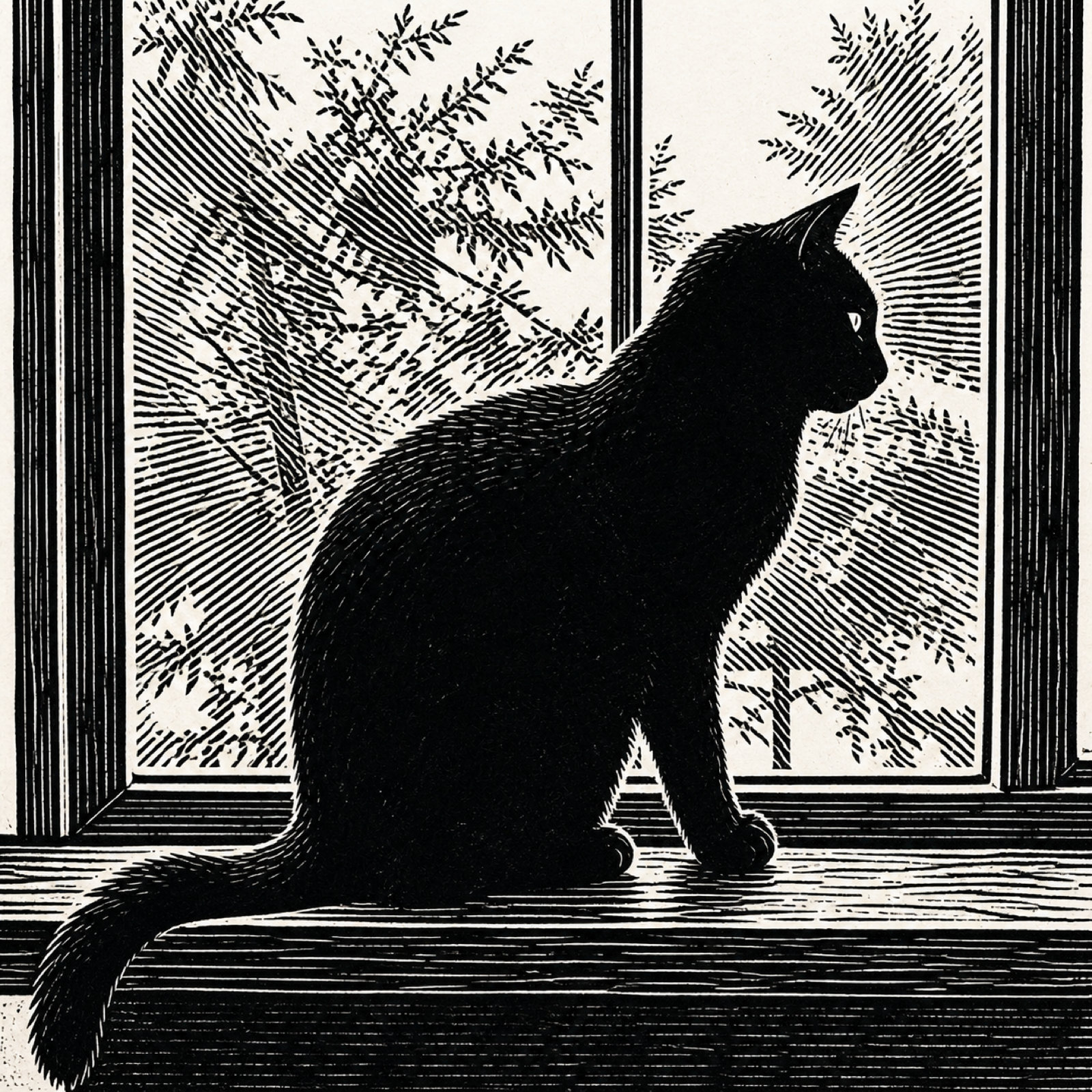
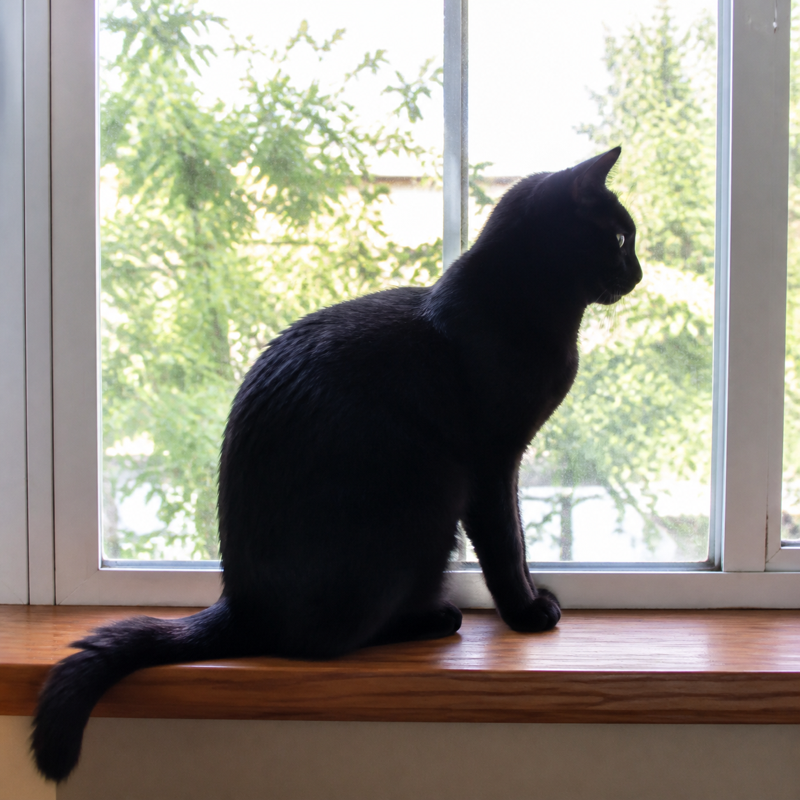
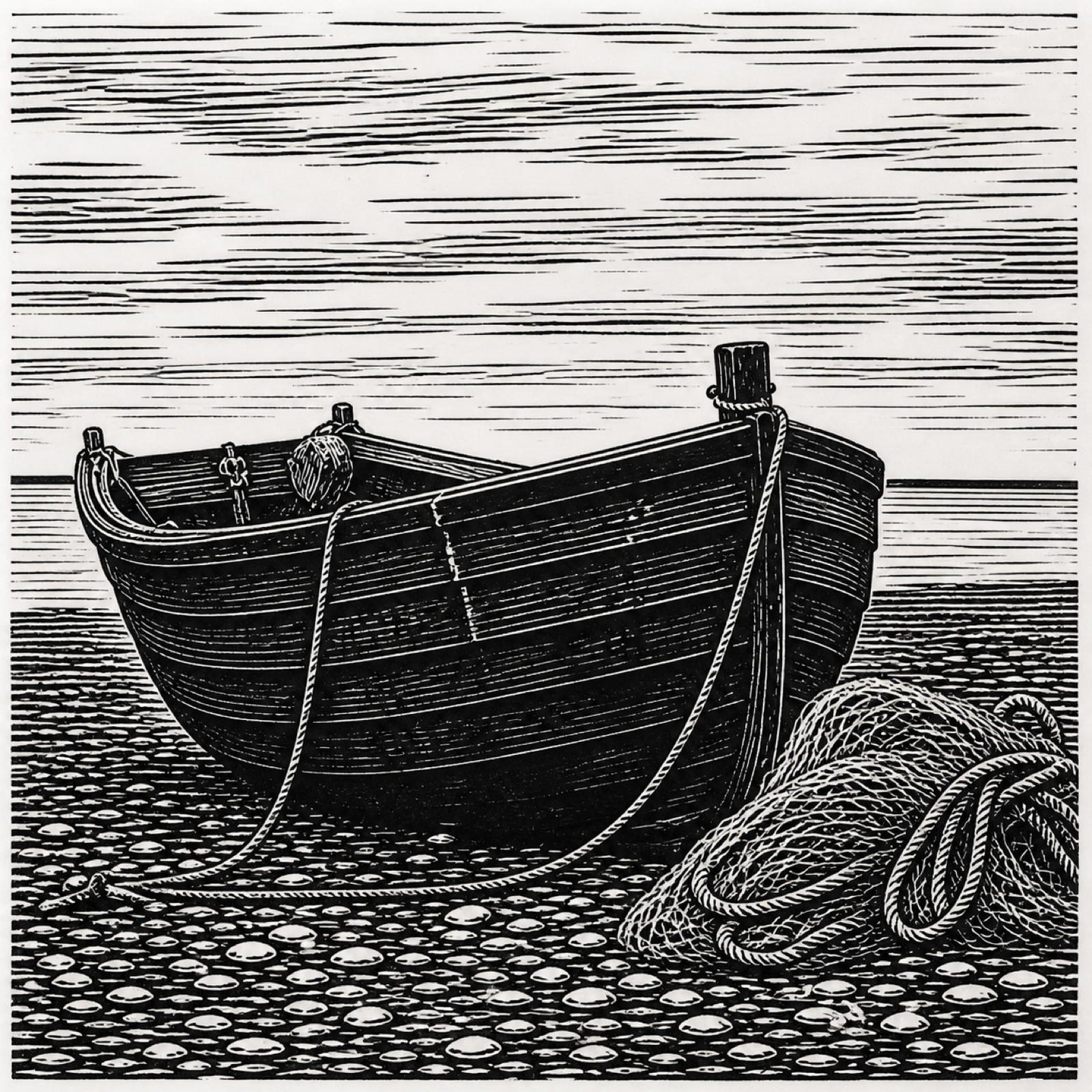
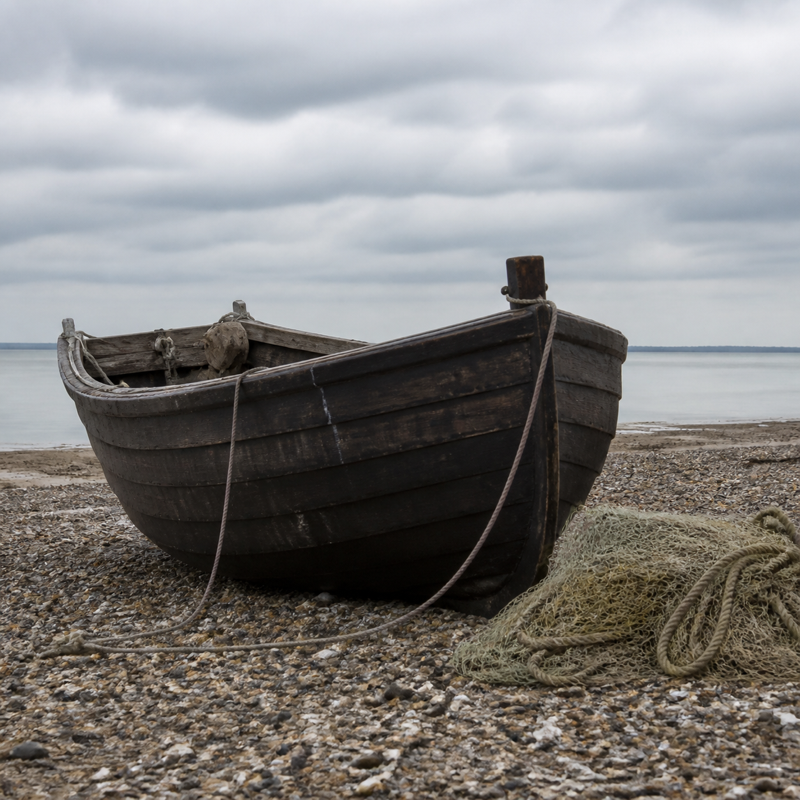
One treatment, two different photographs. A cat against a window and a boat on shingle — one picture whose subject is a silhouette, one whose subject is all texture. The cut direction had to do a different job in each.
The one-sentence claim holds and it is measurable. Only 7.9% of the first result and 10.7% of the second sit anywhere near the middle of the tonal range, and looking at them at full size that fraction is the antialiasing along the edges of the cuts — there is no grey area anywhere in either print. Every middle tone is parallel lines at a spacing: dense in the cat's flank, open in the leaves, wide on the shingle. Cut direction was obeyed closely in both, including the seam where one direction meets another, which is what makes the edges read without an outline. Two things to expect. The runs will not leave a large area bare, however plainly you name it: the window was specified as bare white and came back fully hatched, and so did the sky above the boat. Read the first field as `what is darkest and what is lightest` rather than as a promise of untouched paper. And detail below the blade really does go — the cat's whiskers are absent, and the eye is one black almond with a single white cut in it. That is correct for the medium, and it is worth knowing before you pick a photograph whose point is something thin.
Generated for this library
Input
  Black/white the cat solid black; the window and the sky
              behind it bare white
  Cuts run    curving around the cat's body, and radiating
              outward through the leaves behind the glass
  Photograph  cat.png (1254 x 1254)

Returned   1 image · 1:1 · a block print of the cat

values     two - 7.9% of the pixels sit in the middle
           of the range, and that is the antialiasing
           on the line edges
tone       spacing, not grey - the fur, the leaves and
           the sill are all parallel cuts at different
           pitches
direction  as asked - curving round the cat, radiating
           through the leaves, with the grain on the sill
detail     the whiskers are gone, the eye is one black
           almond with a single white cut
bare white the window was named bare and came back
           hatched; nothing large was left uncut
words none, in any scriptYou fill in 2 fields — the braced lines at the top. Everything below them is fixed.
- 1What is solid black, and what is bare white
- 2Which way the cuts run
The White Is What Was Cut Away
What this makes
Hand it a photograph and it comes back as a woodcut — no grey anywhere, every middle tone made out of parallel cuts spaced wide or close, because a block can only print ink or nothing. Two fields.
You are given ONE photograph. Return ONE image: that photograph as a woodcut — a relief print pulled from a cut block. Follow every line. Replace only the FIELDS block; everything after it is fixed.
First — do you have the photograph and the fields?
Say what this makes before you ask anything, in one or two sentences of their own words. Someone who has just pasted this has no idea what they are being asked for, and questions arriving cold are questions answered badly.
If no photograph is attached, stop and ask for one. This cuts a block from a particular picture; there is nothing to cut without it.
If either field below still has braces around it, stop and ask. Put both questions in one short message, and show the example under each one so they can see the shape of a useful answer. Wait for the replies, then work. Never fill a brace yourself.
Ask in whatever language they are writing to you in. Translate the questions and the examples; do not make someone read English to tell you what they want.
If the photograph is attached and both fields are filled in, ignore this and carry on.
Fields — replace these two lines only
- What is solid black, and what is bare white: {one area of each, named}
- Which way the cuts run: {the direction of the lines, and where}
The law everything else follows from
Everything about how the subject is drawn may change. Nothing about what is in it may.
The rendering becomes a print: two values, a knife, a plank. What is in the picture does not move. Same subject, same pose, same arrangement, same relative sizes, same framing. It is that photograph, cut.
The block prints ink or nothing
This is the whole rewrite, and it is one sentence of physics.
A relief block is inked on its surface and pressed to paper. Every part that touches the paper prints at full strength; every part the knife removed prints nothing. There is no setting in between. So:
- No grey anywhere in the picture. Not a soft shadow, not a gradient, not a wash, not a tint. Every point is ink or paper.
- Middle tones are an illusion made by spacing. A grey area is parallel cuts: wide apart where it should be light, close together where it should be dark. The eye mixes them; the block never did.
- A gradient becomes a change of spacing, and it changes visibly, not smoothly. Bands are correct. A smooth ramp is not.
- Large blacks stay large. Do not break a solid black into texture to make it interesting.
If any part of the result could be described as light grey, the block has not been cut — a picture has been painted to look like one.
The knife has a direction
- Cuts follow the form. Around a cheek they curve with it; along a plank they run with the grain; behind a light they radiate from it.
- The direction changes when the form changes, and the change is a visible seam between two areas of different line direction. That seam is where an edge is.
- Not crosshatching. Two sets of lines crossing is an engraving. Woodcut is one set at a time.
- Line ends are blunt or tapered by the blade, not feathered.
What the blade cannot hold
- Anything narrower than the cut disappears. Whiskers, wires, eyelashes, fine lettering, a chain — these become one thick line, a shape, or nothing.
- Small features become shapes. An eye is a black almond with one cut white; it is not drawn small and accurately.
- The count of things stays right. Losing detail is allowed; losing objects is not.
The impression is uneven
- Ink sits slightly heavier at the edges of large solid areas.
- Wide flats show a little of the block's own grain.
- The odd cut is slightly ragged, and slightly off from its neighbour.
- No paper texture overlay, no scan of a print, no fake wear. This is a clean impression that happens to be handmade.
Never
- Text, numerals, a signature, a caption or a watermark anywhere, in any script.
- Grey, halftone dots, stipple, airbrush or blur.
- A border, a frame, a torn edge, a mock-up or a hanging print.
- Colour beyond the one ink, unless the first field asked for it.
- A subject the photograph did not contain.
What it should read as
A print somebody pulled off a block — legible across a room, and with nothing in it that a knife could not have made.
The whole template, in one piece. The steps below are the entire workflow.
How to use it
- Copy the whole template with the button above.
- Attach the photograph and paste the template in the same message.
- Replace the two FIELDS lines. Name real areas of the picture, not adjectives — 'the cat solid black' rather than 'strong contrast'.
- Look for grey. If any part of the result is a middle grey rather than spaced lines, the run has painted a woodcut instead of cutting one, and the first field was probably too vague about the extremes.
- Check the cut direction in the biggest mid-tone area. Lines that ignore the form are the usual tell that it fell back on a texture.
What you swap
- What is solid black, and what is bare white
- the cat solid black; the window and the sky behind it bare white
- Which way the cuts run
- curving around the cat's body, and radiating outward through the leaves behind the glass
Before it runs
- A photograph, attached to the message, with something in it that reads as a shape. A picture whose subject is separated from its background only by colour has nothing for a knife to find.
- A decision about the two extremes. The first field is the whole composition: what goes fully black and what goes fully white is what the print is, and everything else is cut to get between them.
- Tolerance for losing detail. A woodcut cannot hold anything narrower than the blade, so small things become shapes or disappear. That is the medium, not a failure of the run.
- No text. Cutting type backwards into a block is its own trade and this does not do it.
When to reach for it
When something needs to look printed rather than photographed: a poster, a cover, a label, a masthead, a T-shirt. Templates in this genre ask for a woodcut look and hand back a photograph with the contrast pushed and some scratches over it — grey everywhere, which is the one thing a woodblock cannot do.
What changes
- One photograph in, one relief print out — two values, ink and paper, and nothing between them.
- Middle tones are built from parallel cuts whose spacing carries the value, not from grey.
- The cuts follow the form rather than crosshatching at random, which is what separates a woodcut from an engraving.
- Detail below the width of the knife is dropped into a shape instead of being drawn small.
- One image, no type, no border, no fake print texture laid over the top.
Pairs with
- The Dot Changes Size, the Ink Does NotHand it a photograph and it comes back as a printed halftone — one ink, one screen angle, tone carried entirely by how big the dots are, with the coarseness set against something in the picture. Two fields.
- A Grade Moves No ShadowHand it a snapshot and it comes back graded — a named contrast curve, a named colour split, halation and grain — with every object, every shadow and the whole framing exactly where they were. Two fields.
- A Hole Has No Focal PlaneHand it a photograph and it takes the picture again through a pinhole — no lens, so nothing is ever truly sharp and nothing is ever more blurred than anything else, with the corners falling away because of simple geometry. Two fields.