

The Shutter Adds Every Position Up
Hand it a photograph taken in an instant and it takes the picture again with the shutter held open — where anything that moved is the sum of every place it was, and anything that stayed still comes out sharper than before. Two fields.
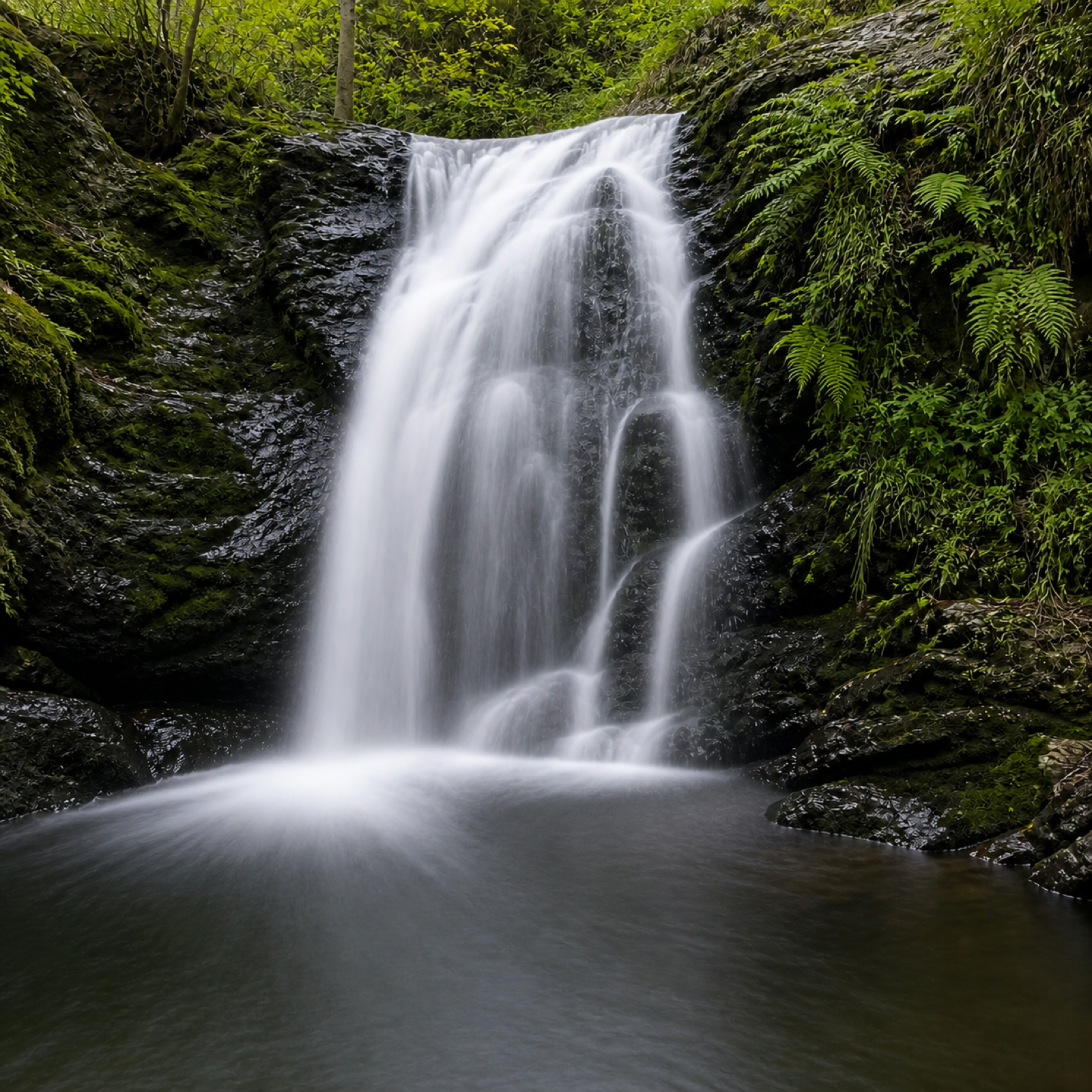
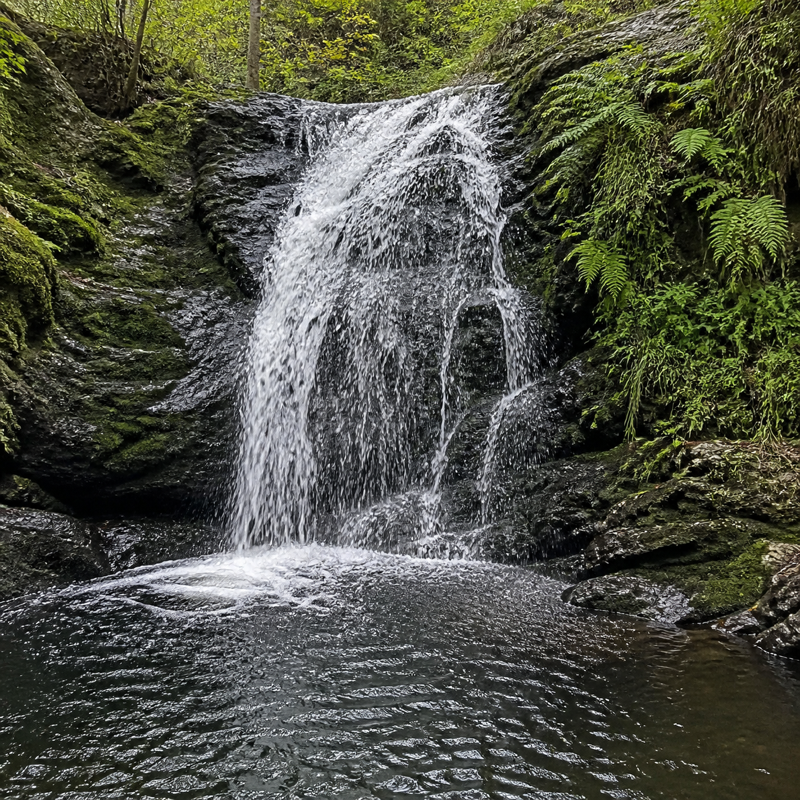
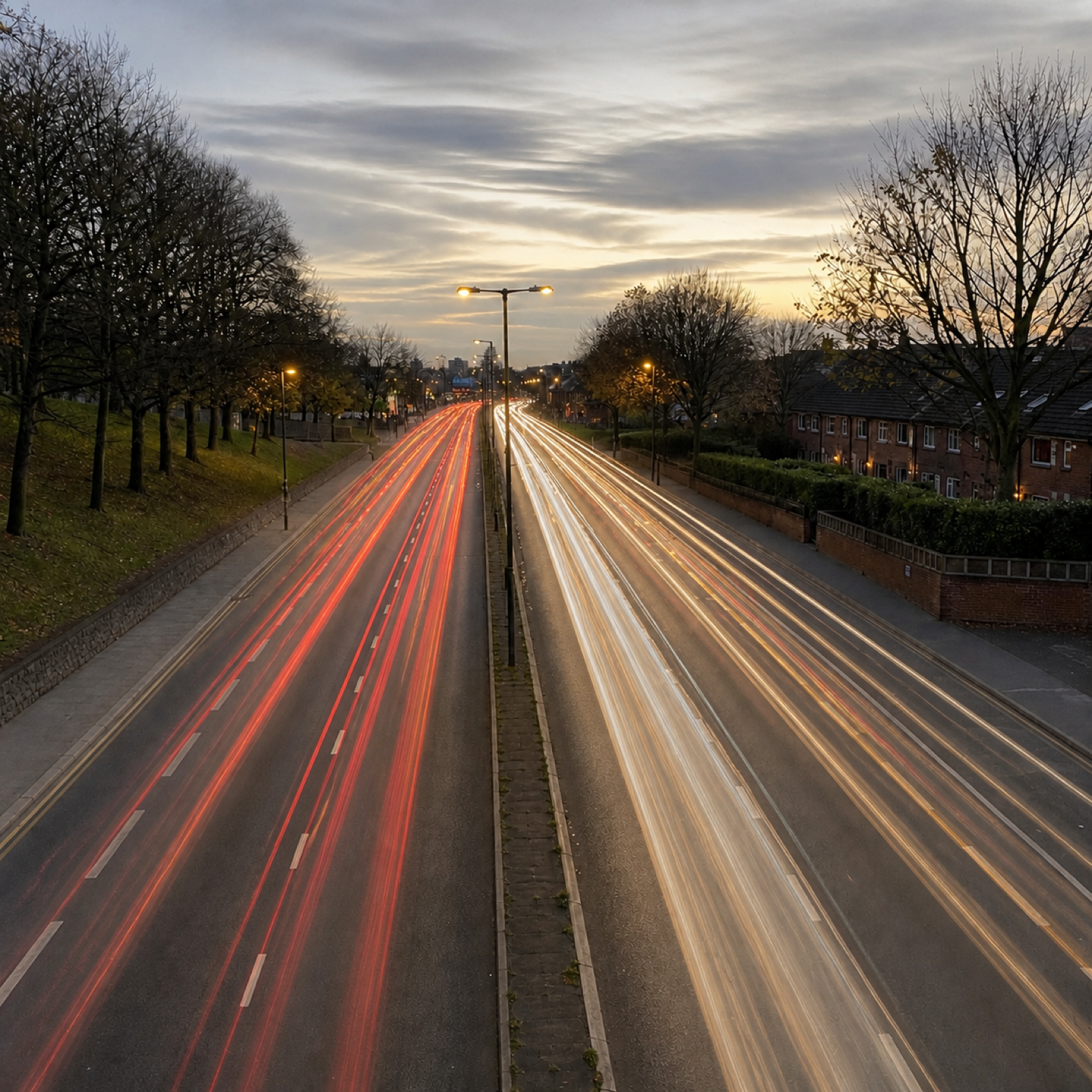
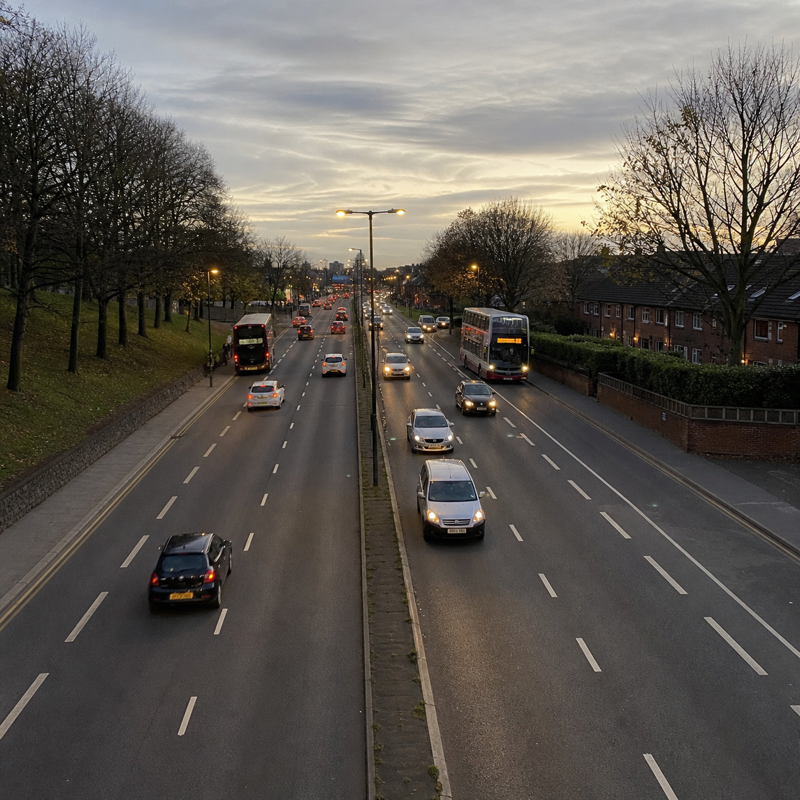
One treatment, two different photographs. A waterfall where the moving thing stays in frame and a road where it leaves entirely — one becomes a smooth mass, the other becomes trails with no cars left in them at all.
Both runs are textbook, and the second is the one that proves the rule is about adding light rather than blurring a picture. The road went in with a bus and a dozen cars sharp on it and came back with no vehicle anywhere — only continuous unbroken trails, red going away and white coming towards, with the road markings still legible underneath and the trees, lamps and houses untouched. Nothing is ghosted and nothing is smeared; the cars simply spread their light too thin to survive, which is what the body says will happen. The waterfall lost every individual droplet and became one smooth mass with radiating trails across the pool, and the clouds drew out along the wind. One claim in the first draft did not survive checking, and it is corrected in the template. It said the still parts come back sharper than the photograph, because a long exposure resolves more. Measured, they come back very slightly softer — 17% less edge energy in the ferns, 10% in the trees — which is invisible at viewing size but is not what was promised. The body now says only that the still parts stay sharp, and the step above asks you to check that they did not go soft along with the water, which is the failure that actually matters.
Generated for this library
Input
  What moved  the water, falling straight down the rock
              face and then out across the pool
  How long    long enough for a drop to travel the whole
              height of the fall
  Photograph  waterfall.png (1254 x 1254)

Returned   1 image · 1:1 · the same fall, shutter held open

streaks    one continuous smooth mass - no droplets
           left anywhere, and radiating trails where
           the water spreads across the pool
still      rocks, moss and ferns crisp; measured 17%
           less edge energy than the source, which is
           not visible at viewing size
gone       nothing had to leave the frame here; on the
           road run every vehicle did, completely
place      same viewpoint, same rocks, same ferns
words none, in any scriptYou fill in 2 fields — the braced lines at the top. Everything below them is fixed.
- 1What moved, and along what path
- 2How long the shutter was open, said as what the moving thing does in that time
The Shutter Adds Every Position Up
What this makes
Hand it a photograph taken in an instant and it takes the picture again with the shutter held open — where anything that moved is the sum of every place it was, and anything that stayed still comes out sharper than before. Two fields.
You are given ONE photograph taken in an instant. Return ONE image: the same scene photographed again with the shutter held open. Follow every line. Replace only the FIELDS block; everything after it is fixed.
First — do you have the photograph and the fields?
Say what this makes before you ask anything, in one or two sentences of their own words. Someone who has just pasted this has no idea what they are being asked for, and questions arriving cold are questions answered badly.
If no photograph is attached, stop and ask for one. This re-photographs a particular place, so there has to be a picture of it.
If either field below still has braces around it, stop and ask. Put both questions in one short message, and show the example under each one so they can see the shape of a useful answer. Wait for the replies, then work. Never fill a brace yourself.
Ask in whatever language they are writing to you in. Translate the questions and the examples; do not make someone read English to tell you what they want.
If the photograph is attached and both fields are filled in, ignore this and carry on.
Fields — replace these two lines only
- What moved, and along what path: {the moving thing, and the route it took}
- How long the shutter was open, said as what the moving thing does in that time: {a journey}
The law everything else follows from
The object is untouched. The photograph of it is taken again.
Everything about the exposure changes. Nothing about the place changes: same viewpoint, same framing, same buildings, same rocks, same trees, same weather. It is that scene, photographed with the shutter open instead of shut.
A long exposure adds; it does not blur
This is the whole rewrite, and it is one sentence about a sensor.
A sensor collects light for as long as the shutter is open and adds it all together. It does not average two pictures and it does not smear one. Every point in the result is the sum of everything that passed across it, weighted by how long it stayed. Everything follows:
- A moving thing becomes one continuous streak along the path the first field names — smooth from end to end, with no edges inside it and no repeated copies of the object.
- The streak is brightest where the thing moved slowest and faintest where it moved fastest, because time on a spot is what makes brightness.
- Something that crossed the frame and left is gone, not faint and not ghosted. It spread its light so thin that nothing of it remains.
- A moving light leaves an unbroken trail the whole length of its path — a continuous line, not a row of dots.
- Water becomes a smooth mass, not many blurred droplets. Every individual drop is gone; what is left is where the water was.
If any moving thing in the result still has its own outline, the picture has been blurred rather than exposed.
What did not move comes out better
- Everything stationary stays sharp. A long exposure on a fixed camera does not soften what is not moving, so the bank, the rocks, the road and the buildings hold every bit of the detail they had.
- The still parts are brighter and fuller. They collected light the whole time: shadows open up, colours deepen, detail appears in places that were dark.
- No overall softness. Do not soften the rocks to match the water. The contrast between a razor-sharp bank and a smooth fall is the entire picture.
- The camera did not move, so nothing shifts, tilts or rotates.
The exposure is longer, so the light is different
- The whole frame is exposed for longer, so bright areas may clip and stay clipped, and dark areas hold detail they did not have.
- A sky over a long exposure smooths out, its clouds drawing into streaks along the wind.
- Colours may shift slightly the way a long exposure shifts them, but nothing is recoloured.
The place does not change
- Same viewpoint, same framing, same focal length.
- Same buildings, rocks, trees, road, signs and their positions.
- Nothing added to the scene that was not photographed: no extra vehicles, no people, no reflections that were not there.
- Things that moved are the things the first field names, and nothing else moves.
Never
- Text, numerals, a caption or a watermark anywhere, in any script.
- Motion blur applied as an effect: ghosted copies, directional smear, radial zoom, a blurred duplicate layer.
- A vignette, a filter, a grain overlay, a light leak or a border.
- Softening the stationary parts.
- A subject the photograph did not contain.
What it should read as
A photograph of the same place with time in it — the bank sharp enough to count the leaves, and the water gone smooth.
The whole template, in one piece. The steps below are the entire workflow.
How to use it
- Copy the whole template with the button above.
- Attach the photograph and paste the template in the same message.
- Replace the two FIELDS lines. Describe the path the way you would trace it with a finger.
- Check the still parts first. They should still be crisp — a long exposure on a fixed camera does not smear the bank. If they have gone soft along with the water, the run blurred the picture instead of re-exposing it.
- Then check a streak. It should be one continuous smooth band, not several ghosted copies of the same object.
What you swap
- What moved, and along what path
- the water, falling straight down the rock face and then out across the pool
- How long the shutter was open, said as what the moving thing does in that time
- long enough for a drop to travel the whole height of the fall
Before it runs
- A photograph, attached to the message, in which something is plainly moving and something else is plainly not. The whole picture is the contrast between them.
- A path, not a direction. 'The water moved' produces a smear; 'down the rock face and then out across the pool' produces a shape.
- A duration expressed as a journey. Seconds mean nothing to a run with no clock; 'long enough for a car to cross the frame' is something it can draw.
- Something still in the frame worth keeping sharp. Without it the result is just a blurred photograph and proves nothing about time.
When to reach for it
When a picture needs to show that something was moving: water, traffic, a crowd, a fairground, a sky. Templates in this genre ask for a dreamy long-exposure effect and hand back the same photograph with motion blur smeared over the moving parts, which is a still picture with a filter on it.
What changes
- One photograph in, one long exposure out — same place, same camera position, shutter held open.
- Moving things become the sum of every position they held, so they smooth into continuous streaks rather than blurred copies.
- Anything that never moved comes back sharper and brighter than it was, because it collected light the whole time.
- Something that crossed the frame and left is gone rather than faint, which is the difference between adding light and blending pictures.
- One image, no grain overlay, no vignette, no border.
Pairs with
- A Grade Moves No ShadowHand it a snapshot and it comes back graded — a named contrast curve, a named colour split, halation and grain — with every object, every shadow and the whole framing exactly where they were. Two fields.
- A Hole Has No Focal PlaneHand it a photograph and it takes the picture again through a pinhole — no lens, so nothing is ever truly sharp and nothing is ever more blurred than anything else, with the corners falling away because of simple geometry. Two fields.
- A Line at a Constant HeightHand it a photograph and it comes back as contour lines — every line a closed loop at one depth, none of them crossing, none of them stopping in mid-air, with the spacing doing all the shading. Two fields.