

The Second Picture Lives in the Dark
Hand it a portrait and it comes back as a double exposure — a second scene held inside one tonal range of the face, with the silhouette left clean so the person still reads. Two fields.


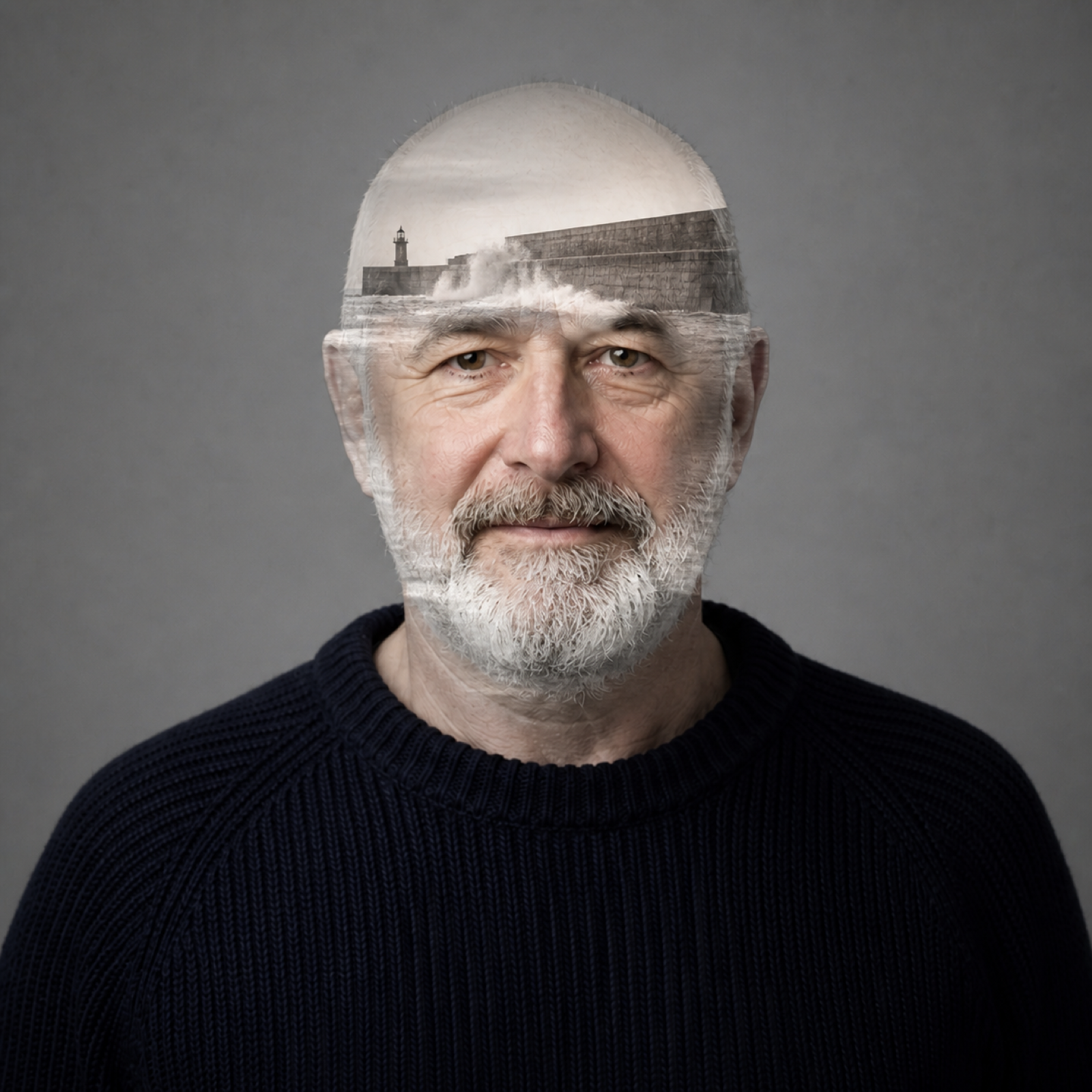

One treatment, two different photographs. A forest into the shadows of one portrait, a harbour into the highlights of another — the same rule pointed at opposite ends of the tonal range, which is the test of whether the rule is a rule.
One run proves the idea and the other shows exactly how it fails. On the first the forest sits in the cardigan and the hair and nowhere else; the lit face, both eyes and the jawline carry nothing, the silhouette stays sharp, and she is recognisably herself shrunk to a thumbnail. That is the whole argument for naming a tonal range instead of asking two pictures to blend artfully. The second run asked for the highlights and the beard, and the run put the harbour across the top of the bald scalp with a hard horizontal edge — a mask cut as a shape, which the body forbids in those words, and nothing in the beard at all. The likely cause is in the photograph: the scalp is the brightest area by a distance, so `highlights` selected one region rather than a range spread through the picture. Read it as a rule that binds when the tonal range you name is spread across the frame, and breaks into a pasted shape when it lands on one bright patch. Choose the range by looking at where it actually falls in your own photograph.
Generated for this library
Input
  Second      a pine forest on a ridge at dusk, seen from
  picture     below so the trunks run vertically
  Lives in    only in the shadows and the hair - the lit
              side of the face, both eyes and the jawline
              stay clear of it
  Photograph  portrait.png (1254 x 1254)

Returned   1 image · 1:1 · one face, one forest

tones      the forest is in the cardigan and the hair -
           the shadow range, and nowhere else
protected  kept: the lit side of the face, both eyes and
           the jawline carry nothing at all
silhouette clean against the grey, uninterrupted
person     reads as her at any size - curls, glasses,
           brows and expression all unchanged
words none, in any scriptYou fill in 2 fields — the braced lines at the top. Everything below them is fixed.
- 1The second picture
- 2Which tones it lives in, and what stays clean
The Second Picture Lives in the Dark
What this makes
Hand it a portrait and it comes back as a double exposure — a second scene held inside one tonal range of the face, with the silhouette left clean so the person still reads. Two fields.
You are given ONE portrait. Return ONE image: a double exposure of that person with a second scene inside them. Follow every line. Replace only the FIELDS block; everything after it is fixed.
First — do you have the photograph and the fields?
Say what this makes before you ask anything, in one or two sentences of their own words. Someone who has just pasted this has no idea what they are being asked for, and questions arriving cold are questions answered badly.
If no photograph is attached, stop and ask for one. The face in this is a particular face, so there has to be a picture of it.
If either field below still has braces around it, stop and ask. Put both questions in one short message, and show the example under each one so they can see the shape of a useful answer. Wait for the replies, then work. Never fill a brace yourself.
Ask in whatever language they are writing to you in. Translate the questions and the examples; do not make someone read English to tell you what they want.
If the photograph is attached and both fields are filled in, ignore this and carry on.
Fields — replace these two lines only
- The second picture: {a scene, and the direction its lines run}
- Which tones it lives in, and what stays clean: {a tonal range, and the parts to protect}
The law everything else follows from
Everything about how the subject is drawn may change. Nothing about what is in it may.
The portrait's rendering is replaced: it stops being a photograph of a lit face and becomes two pictures occupying one frame. Who it is does not change. The head keeps its shape, the features keep their positions and proportions, and the person is still identifiable when the picture is the size of a thumbnail.
The second picture lives in one tonal range
This is the whole rewrite. Sources in this genre say the two images blend artfully, which decides nothing, so the second picture spreads everywhere and the face dissolves. It has to be confined, and the thing that confines it is tone:
- The second picture appears only in the range the field names — the shadows, or the highlights, or the midtones. Outside that range the portrait is untouched.
- Where it appears it is fully present, at its own contrast, not a ghost at ten percent over the whole frame.
- The boundary is the portrait's own tonal edge, not a soft mask drawn over it. Where the light on the face falls away, that is where the forest starts.
- The protected parts named in the field carry nothing at all. No branch across an eye, no horizon through the mouth.
The silhouette stays clean
- The outline of the head, hair and shoulders stays sharp against the background, uninterrupted by the second picture.
- The second picture does not spill outside the person, and the background does not fill with it either. If the background changes at all, it goes plainer, not busier.
- Test it small. Shrunk to a thumbnail the picture should still read as a person. If it reads as texture, the tonal range was too wide.
The person still reads
- Eyes, brows, nose and mouth keep their shape and their positions.
- The face is not smoothed, slimmed, aged or beautified under cover of the effect.
- Skin keeps its own tone where the second picture is not present.
- The head's angle and the expression are the photograph's.
The second picture
- Rendered as described in the field, with its lines running the direction the field says — that direction is what makes it legible at small scale.
- One scene only. Not a montage, not three landscapes, not a collage.
- Its own colour, or the portrait's, but decided and consistent.
Never
- Text, numerals, a signature or a watermark anywhere, in any script.
- A second face, a reflection, or a mirrored copy of the subject.
- A border, a frame, a vignette, a grain overlay or a light leak.
- The second picture over the eyes, or over anything the field protects.
- Any change to who the person is.
What it should read as
One photograph that happens to contain two — and from across a room you see the person first.
The whole template, in one piece. The steps below are the entire workflow.
How to use it
- Copy the whole template with the button above.
- Attach the portrait and paste the template in the same message.
- Replace the two FIELDS lines. Protect the eyes in the second field unless you have a reason not to.
- Look at it small before shipping. A double exposure that only reads at full size has not worked — the silhouette is what carries it in a feed.
- If the person has vanished into the scenery, name a narrower tonal range rather than a smaller second picture.
What you swap
- The second picture
- a pine forest on a ridge at dusk, seen from below so the trunks run vertically
- Which tones it lives in, and what stays clean
- only in the shadows and the hair — the lit side of the face, both eyes and the jawline stay clear of it
Before it runs
- A portrait, attached to the message, with clear separation between the lit and shadowed sides. A flat, evenly lit face has no tonal range for the second picture to live in.
- Permission from the person, if it is not you.
- A second picture with its own direction. Vertical trunks, horizontal waves, a city's verticals — something whose lines will read at a small scale inside a face.
- A decision about what stays clean. Whatever you do not protect will be blended over, and the eyes are usually the first thing lost.
When to reach for it
When a portrait has to carry an idea as well as a face: a poster, a cover, a title card, a programme. Templates in this genre say the images blend artfully, which decides nothing, so the second picture spreads across the whole frame and the person disappears into it.
What changes
- One portrait in, one double exposure out — the same person, with a second scene inside them.
- The second picture is confined to one tonal range you name, which is what stops it swallowing the face.
- The silhouette stays clean, so the person is still a person at thumbnail size.
- The features you name stay legible through the blend rather than dissolving into texture.
- One image, no type, no border, nothing else added to the frame.
Pairs with
- A Grade Moves No ShadowHand it a snapshot and it comes back graded — a named contrast curve, a named colour split, halation and grain — with every object, every shadow and the whole framing exactly where they were. Two fields.
- A Hole Has No Focal PlaneHand it a photograph and it takes the picture again through a pinhole — no lens, so nothing is ever truly sharp and nothing is ever more blurred than anything else, with the corners falling away because of simple geometry. Two fields.
- A Line at a Constant HeightHand it a photograph and it comes back as contour lines — every line a closed loop at one depth, none of them crossing, none of them stopping in mid-air, with the spacing doing all the shading. Two fields.