

The Same Things, Fewer Lines
Hand it a photograph and it returns a poster in two halves — the picture on top, the same things drawn beneath it in flat colour, countable one against the other. Three fields.
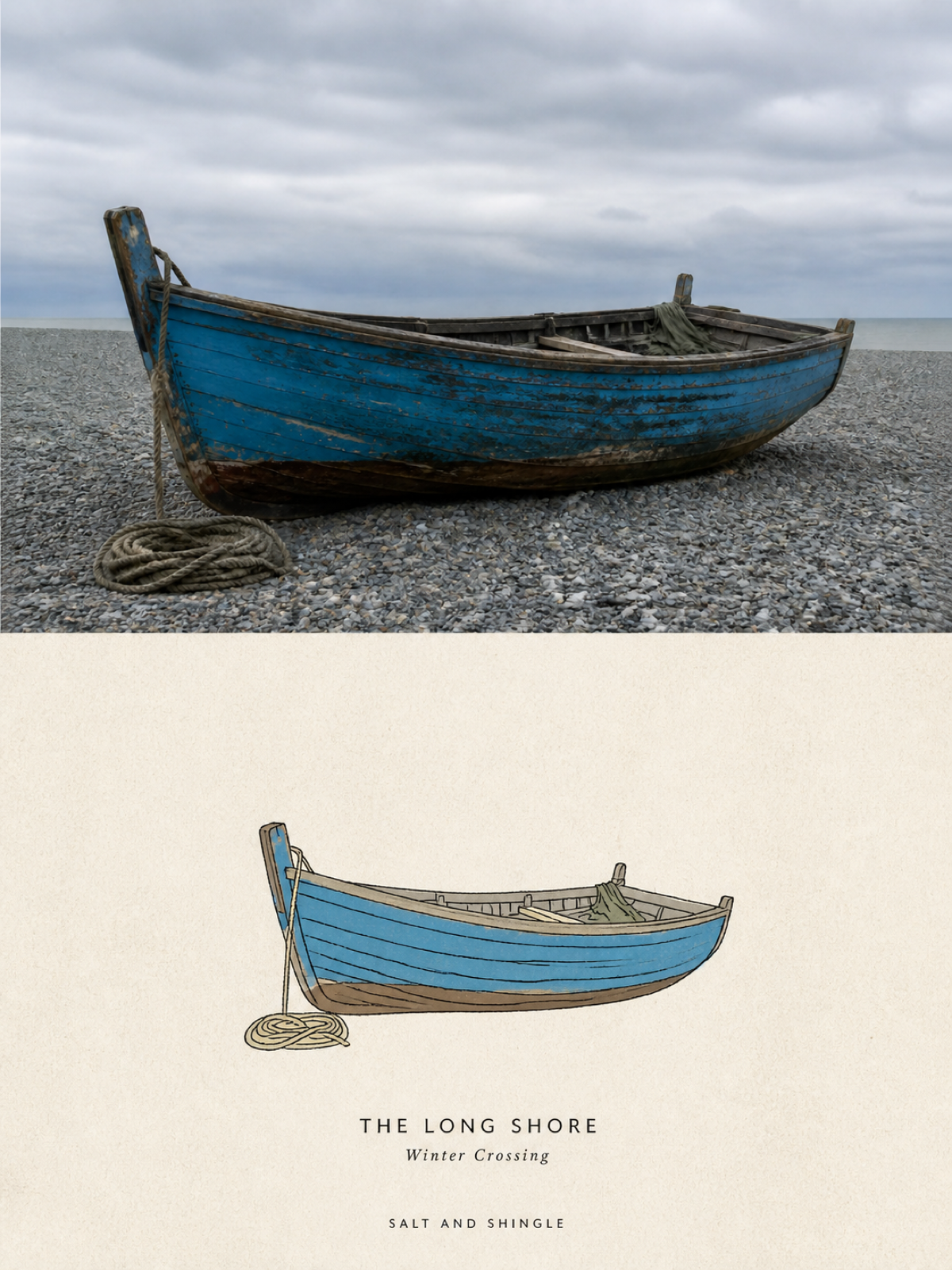
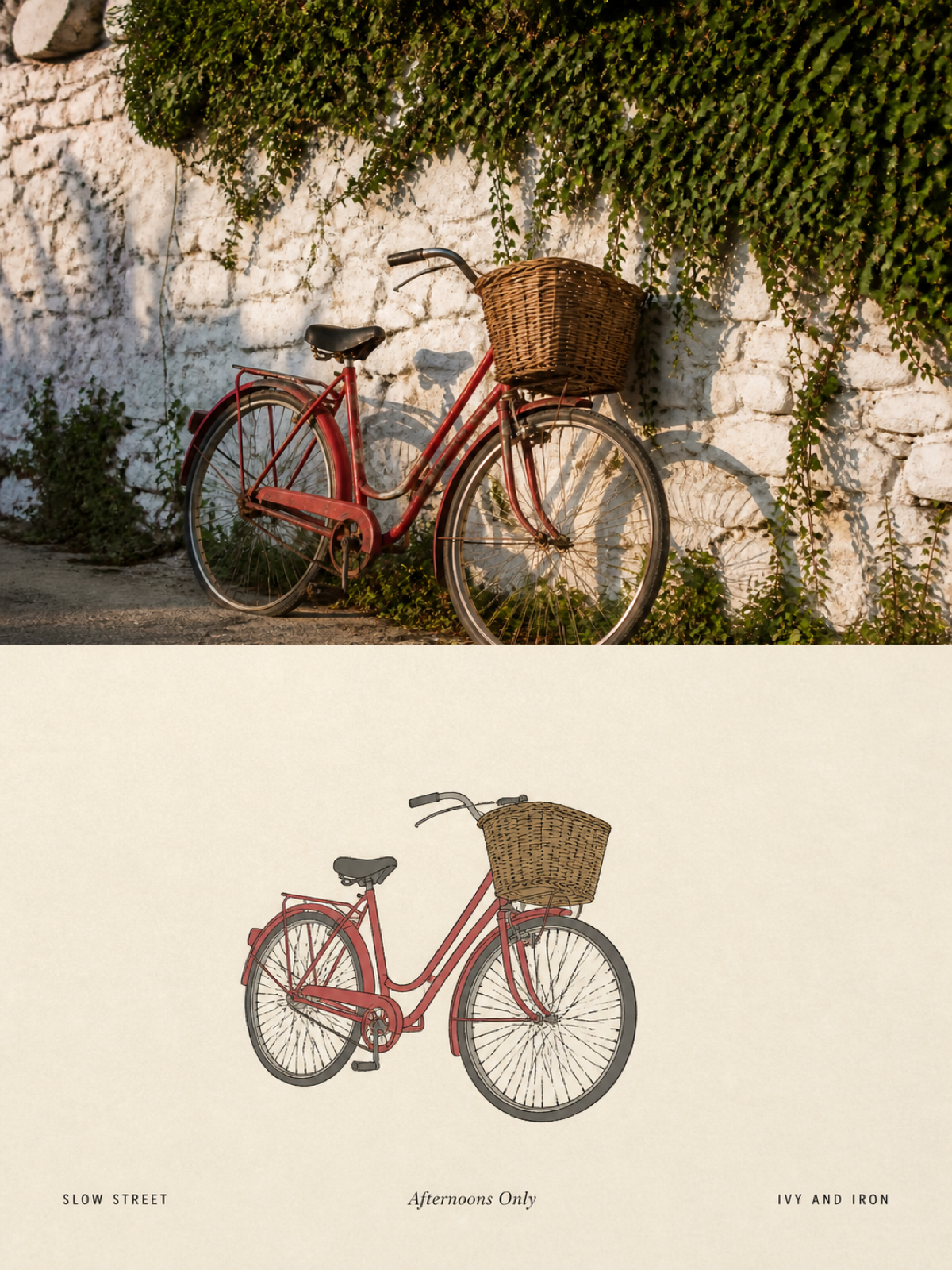

One treatment, two different photographs. A beached boat and a bicycle against a wall, drawn two different ways — flat acrylic blocks on one, a thin line with two marker colours on the other. Both photographs are full of things the field did not name, and neither drawing contains any of them.
Two of the three rules this rewrite added bound, and the third bound only halfway. The words are exact: each poster carries the three lines it was given and nothing else. Worth knowing what that is measured against — the reference template, run once on this same photograph, invented a title, a subtitle, a series number, a three-word footer and the year 2024, none of which anybody typed and one of which is a claim about the reader's picture. The count is exact too, and it took a correction to get there: told only that the drawing holds the things in the photograph, the first bicycle run drew the ivy, the grass and the ground as well, because they are in the photograph. Making the field's list the authority — draw these, and nothing else that happens to be there — emptied the scenery out of both. What still does not bind is the size. Bare paper measures 90% and 89% of the lower half, past the three quarters asked for, but the subject comes back around three fifths of the width it spans in the photograph above rather than the third the template names. Stated as a fraction of the lower half it bound not at all, in the reference and in the first version of this; stated as a comparison it moved a long way and stopped short. Read it as a template that will give you a small drawing but not as small as it says.
Generated for this library
Input
  In the photo  a wooden fishing boat, and a coil of rope
                beside it
  Drawn as      flat acrylic blocks with a thin unsteady
                ink line
  Words         title THE LONG SHORE · under it Winter
                Crossing · foot SALT AND SHINGLE
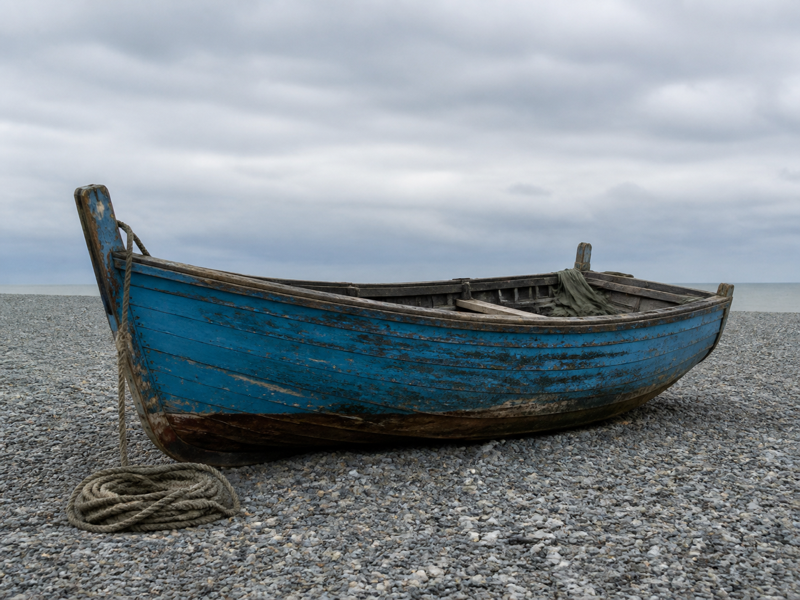
  Photograph    boat-beach.png (1254 x 940)

Returned   1 poster · 3:4 · halved 1:1

top       the photograph, graded, extended to the frame -
          the boat itself unstretched and unmoved
bottom    two things listed, two things drawn: the boat,
          and the rope at its bow - no shingle, no sea
size      90% of the lower half is bare paper - but the
          boat is wider than the third it was held to
colour    four flats, all lifted from the picture above -
          hull blue, wet timber, shingle grey, paper
words     the three lines given and nothing else - no
year, no number, no place nobody typedYou fill in 3 fields — the braced lines at the top. Everything below them is fixed.
- 1What is in the photograph, thing by thing
- 2How the lower half is drawn
- 3The words, and where each one goes
The Same Things, Fewer Lines
What this makes
Hand it a photograph and it returns a poster in two halves — the picture on top, the same things drawn beneath it in flat colour, countable one against the other. Three fields.
You are given ONE photograph. Return ONE poster, 3:4 portrait, in two halves of exactly equal height: the photograph above, and a drawing of the same things below. Follow every line. Replace only the FIELDS block; everything after it is fixed.
First — do you have the photograph and the fields?
Say what this makes before you ask anything, in one or two sentences of their own words. Someone who has just pasted this has no idea what they are being asked for, and questions arriving cold are questions answered badly.
If no photograph is attached, stop and ask for one. The lower half is a drawing of the upper half, so without a picture there is nothing to draw.
If any field below still has braces around it, stop and ask. Put all the questions in one short message, and show the example under each one so they can see the shape of a useful answer. Wait for the replies, then work. Never fill a brace yourself.
Ask in whatever language they are writing to you in. Translate the questions and the examples; do not make someone read English to tell you what they want.
If the photograph is attached and the fields are filled in, ignore this and carry on.
Fields — replace these three lines only
- What is in the photograph, thing by thing: {two or three things, named separately}
- How the lower half is drawn: {a line and a way of laying colour}
- The words, and where each one goes: {the exact words, or the word none}
The law everything else follows from
Everything about how the subject is drawn may change. Nothing about what is in it may.
This is a redrawing, not a restaging: the lower half is allowed to throw away the photograph's light, depth, texture and detail entirely and say the same thing in four flat colours. What it is not allowed to do is say a *different* thing — add a bird that was not there, drop the rope that was, or turn one boat into two.
What survives, and what does not
Survives, and is checkable:
- The things — exactly the ones the first field names. That list is the whole contents of the drawing. Not the things it does not name, however plainly they are in the photograph: not the wall, not the ivy, not the ground, not the weeds, not the sky. A photograph is full of things; the field says which of them this poster is about.
- How many. The number of things in the drawing equals the number of things in the field's list. Not more and not fewer.
- The order. Left to right in the drawing matches left to right in the photograph, so the eye can travel between the halves.
- Which way things face. A boat pointing left goes on pointing left.
Does not survive, and should not:
- Light, shadow, depth, reflection, weathering, surface detail.
- The background. The drawn half stands on paper, not in a place.
- Anything the eye cannot separate into a thing: crowds, foliage, ripples, gravel.
The test is a count, not a resemblance. Read the field's list, then point at each thing in the drawing. Every item on the list has one thing; every thing has one item. A drawing with something extra in it is wrong however good it looks, and the extras arrive as scenery — plants, ground, wall — because the photograph had them.
The two halves
- 3:4 portrait, split across the middle into halves of exactly equal height.
- Top half: the photograph. Graded, not rebuilt — a magazine's colour pass, nothing more.
- To meet the half's shape the photograph may be extended at sky, ground, wall or water, continuing what is already there. The subject is never stretched, never moved, never recoloured, and never cropped into.
- Bottom half: paper. A pale, slightly grainy sheet. Not white, not a place, not a gradient.
The drawing
- The drawing is small, and the way to make it small is to compare it with the half above. The subject spans a good part of the photograph; in the drawing it spans no more than a third of the width it spans up there, and sits clear of the lower half's edges on every side. Put another way: at least three quarters of the lower half is bare paper with nothing on it.
Both of those are checkable against the poster itself, which is why they are written that way. A fraction of the lower half's height is the obvious rule and it does not bind — stated as one, this template and the reference it came from both returned a drawing filling half the sheet. Compare, do not measure.
- A thin line, drawn rather than traced. Slightly unsteady, varying a little in weight, breaking where a hand would lift. It states structure only.
- Flat colour blocks, four at most, every one of them sampled from the photograph above — take the hull's blue from the hull. The blocks are complete and sit slightly off the line, the way a hand fills a shape.
- Paper grain shows through. Edges are a little irregular.
- No pencil shading, no crayon, no watercolour bleed, no gradient, no gloss, no drop shadow, no 3D.
The words
Only the words the field gives, exactly as it gives them.
- Set them in the lower half, in the paper margin, small and far apart.
- Every position the field does not fill stays empty. If the field says none, the poster carries no words at all.
- One typeface, two sizes at most.
Never
- A word the field did not give. No title, no subtitle, no place name, no year, no issue or series number, no caption. These read as facts about the reader's photograph, and inventing a fact is a different act from choosing a colour.
- Any script other than the one the field is written in. Set the given words and only those, character for character.
- Lettering anywhere inside the photograph half.
- A watermark, a border, a frame, a sticker, a fold or a mock-up shadow.
- A second copy of the subject, or a thing in the drawing that is not in the photograph.
What it should read as
A page from a quiet book: a photograph, and under it someone's small drawing of the same thing, made with four colours and a pen because that was what was on the table.
The whole template, in one piece. The steps below are the entire workflow.
How to use it
- Copy the whole template with the button above.
- Attach your photograph and paste the template in the same message.
- Replace the three FIELDS lines. In the first, list the things separately — that list is what the drawing is checked against.
- Count before shipping: every thing in the drawing should be a thing you can point to in the photograph, and there should be the same number of them. That is the check this template is built around.
- Write the words yourself in the third field, in whatever language you want them. Anything you do not write does not appear.
What you swap
- What is in the photograph, thing by thing
- a wooden fishing boat, and a coil of rope beside it
- How the lower half is drawn
- flat acrylic blocks with a thin unsteady ink line
- The words, and where each one goes
- title THE LONG SHORE · under it Winter Crossing · foot SALT AND SHINGLE
Before it runs
- An actual photograph, attached to the message. There is nothing here for a description to work on — the lower half is a drawing *of* the upper half, so without a picture there is nothing to draw.
- A photograph with countable things in it. Two or three objects that can be named separately is the shape this works on; a crowd, a forest or a pattern has nothing to hold a one-to-one correspondence against.
- Room above and below the subject. The frame becomes 3:4 and the photograph fills the top half of it, so a picture cropped tight to its subject has to be extended to fit, and extending is where a horizon goes wrong.
- Your own words, or none. The template will not invent a title, a year or a series number, which means a poster with nothing in the third field comes back with nothing written on it.
When to reach for it
When a photograph has to become something worth pinning up: a travel print, a shop's own poster, a cover for a set of pictures. Templates in this style ask for the most recognisable subject, highly distilled, and hand back a traced copy of the photograph with an invented year and a series number under it.
What changes
- One photograph in, one poster out — 3:4, halved exactly, the picture above and a drawing of it below.
- The drawing holds exactly the things you listed, in the same number and the same order, so the two halves can be counted against each other — and no scenery the photograph happened to contain.
- The drawn subject is held to a third of the width it spans in the photograph above, which is a comparison the poster can be checked against rather than a fraction that never binds.
- At most four flat colours, all sampled from the photograph above, so the halves belong to one picture.
- The only words on it are the words you gave it — every position you leave empty stays empty.
Pairs with
- Drawn On, Not Drawn InHand it a photograph and it draws over the top of it — every doodle attached to a thing you named and doing one job to it, the photograph underneath untouched. Three fields.
- A Grade Moves No ShadowHand it a snapshot and it comes back graded — a named contrast curve, a named colour split, halation and grain — with every object, every shadow and the whole framing exactly where they were. Two fields.
- A Hole Has No Focal PlaneHand it a photograph and it takes the picture again through a pinhole — no lens, so nothing is ever truly sharp and nothing is ever more blurred than anything else, with the corners falling away because of simple geometry. Two fields.