
The Light Travels With the Sensor
Hand it a photograph of a thing and it comes back as a flatbed scan — no perspective at all, and everything lifted off the glass falling to black within a couple of centimetres. Two fields.


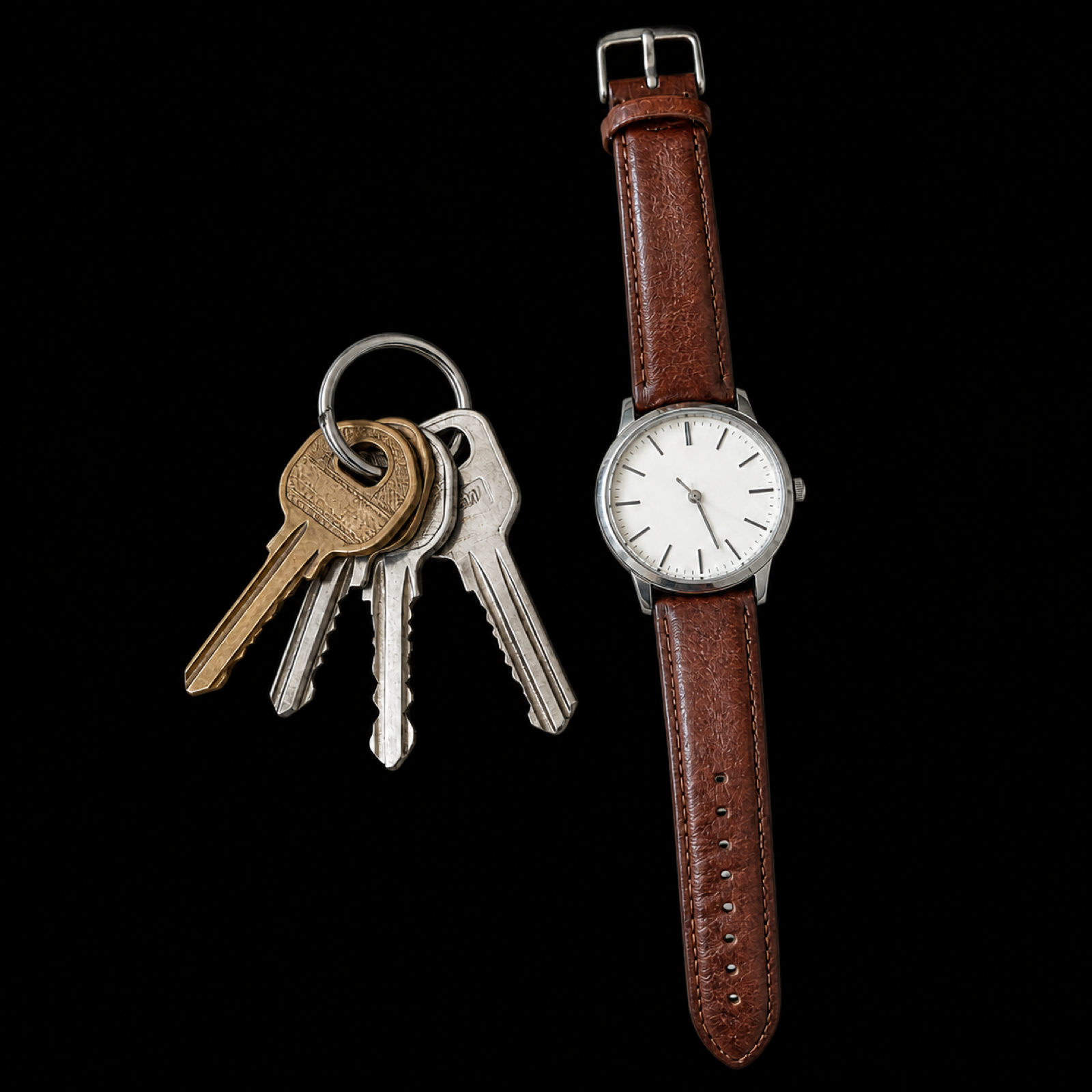
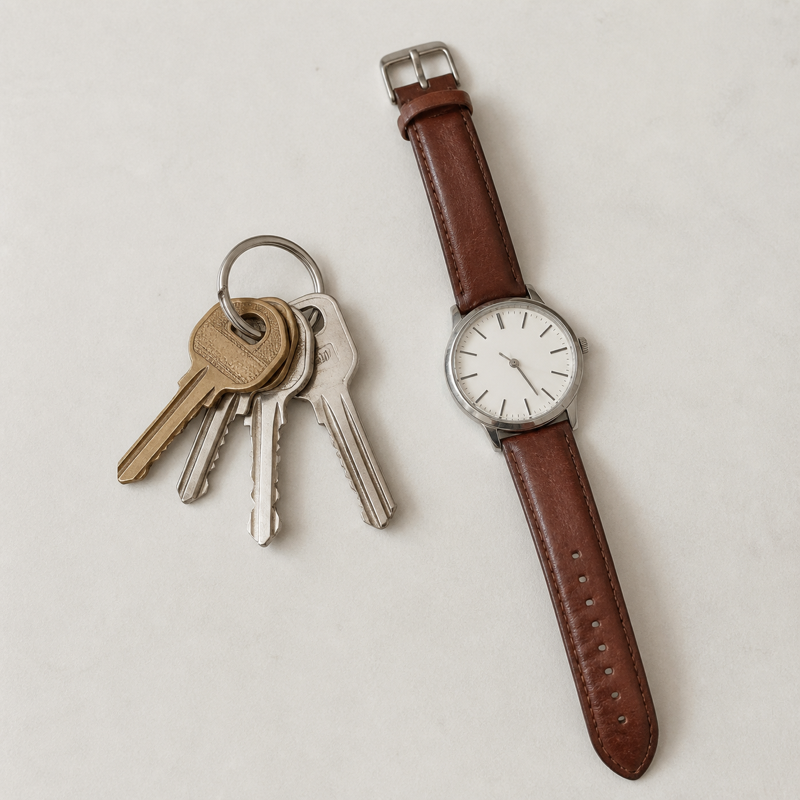
One treatment, two different photographs. Cut poppies and a handful of keys with a watch — one soft subject and one hard one, both with parts that stand well clear of the glass.
One half of this template binds and the other does not, and the half that fails is the one that makes a scan look like a scan. What works: the ground is black rather than a white studio sweep, there is no drop shadow and no reflection, nothing converges, and the detail where things press flat is far beyond what a camera would give. What does not work is the falloff. The second field named the top of the poppy head and the top of the watch case as the places where there should be nothing left but black, and in both runs those parts came back fully lit and fully detailed. The result is an object cut out on black — the look of a scan without its physics. This is the same failure as several others in this set: the instruction asks for part of the subject to be swallowed, and an instruction whose effect is to hide the subject does not bind. Read this as a good way to get a flat, black-backed, orthographic record, and do not expect the lamp's distance to be modelled.
Generated for this library
Input
  On glass    the leaves and the flat side of the stem
  Standing    the flower heads
  Falls away  by the top of the flower head there is
              nothing left but black
  Photograph  poppies.png (1254 x 1254)

Returned   1 image · 1:1 · the poppies scanned

perspective none visible - the watch face is round,
            the keys lie flat, nothing converges
falloff     did not happen: the poppy heads and the
            watch case stand off the glass and are
            fully lit
detail      very high where things press flat
ground      black, with no shadow and no sweep
words none, in any scriptYou fill in 2 fields — the braced lines at the top. Everything below them is fixed.
- 1What is lying flat on the glass, and what is standing off it
- 2How quickly it falls away, said against something in the picture
The Light Travels With the Sensor
What this makes
Hand it a photograph of a thing and it comes back as a flatbed scan — no perspective at all, and everything lifted off the glass falling to black within a couple of centimetres. Two fields.
You are given ONE photograph of ONE thing. Return ONE image: that thing laid on a flatbed scanner with the lid open, and scanned. Follow every line. Replace only the FIELDS block; everything after it is fixed.
First — do you have the photograph and the fields?
Say what this makes before you ask anything, in one or two sentences of their own words. Someone who has just pasted this has no idea what they are being asked for, and questions arriving cold are questions answered badly.
If no photograph is attached, stop and ask for one. This scans a particular object; there is nothing to lay on the glass without it.
If either field below still has braces around it, stop and ask. Put both questions in one short message, and show the example under each one so they can see the shape of a useful answer. Wait for the replies, then work. Never fill a brace yourself.
Ask in whatever language they are writing to you in. Translate the questions and the examples; do not make someone read English to tell you what they want.
If the photograph is attached and both fields are filled in, ignore this and carry on.
Fields — replace these two lines only
- What is lying flat on the glass, and what is standing off it: {the parts that touch, and the parts that do not}
- How quickly it falls away, said against something in the picture: {a named part, and how dark it is by then}
The law everything else follows from
The object is untouched. The photograph of it is taken again.
Everything about the recording changes: no lens, no room, no photographer — a bar of light and a sensor sliding under a sheet of glass. Nothing about the object changes. Same shape, same colour, same markings, same wear. It is that thing, laid down and scanned.
Two facts, and everything follows from them
This is the whole rewrite.
First: the light moves with the sensor. A scanner lights one thin line at a time and reads that same line. The lamp is a few millimetres from the glass, so:
- Whatever touches the glass is brightly and evenly lit, edge to edge, with no hot spot and no falloff across the picture.
- Whatever is lifted off the glass darkens fast — much faster than it would in a room, because the lamp is so close that a centimetre is a large fraction of the distance.
- A couple of centimetres up, there is nothing at all. Not dim: black. The part the second field names is where that has happened.
- The far side of an object is never lit, because the lamp is always directly beneath.
- The background is black. The lid is open and there is nothing up there to return any light.
Second: a scanner has no perspective. Each line is read from directly beneath, so the projection is orthographic:
- Parallel edges stay parallel. Nothing converges, nothing foreshortens, there is no vanishing point anywhere in the picture.
- You see only the top. A box shows its lid and none of its sides. A bottle lying down shows its length and not its ends.
- A thing is the same size wherever it sits on the glass, near edge or far.
- Everything is equally sharp across the whole bed, as far as the falloff allows.
If two parallel lines converge anywhere in the result, this was photographed and not scanned.
Depth of field is millimetres
- What presses flat is extremely detailed — the sensor is closer than any camera gets, so a leaf's veins, a scratch, a fibre and a fingerprint are all visible.
- What curves away from the glass goes soft within a finger's width, and dark at about the same rate.
- Soft and dark arrive together. Nothing is soft and still bright.
The object does not change
- Same colour, under a light that is even and slightly cool.
- Same shape, same proportions, same markings, same damage.
- It may be squashed slightly where it presses on the glass, the way a petal or a fingertip flattens.
- Nothing added: no props, no water drops, no scattered petals.
Never
- Text, numerals, a scale bar, a caption, a label or a watermark anywhere, in any script.
- Perspective, foreshortening, a vanishing point or a horizon.
- A white background, a drop shadow, a reflection, a gradient or a studio sweep.
- A visible scanner, a lid, a hand, a bed edge, a frame or a mock-up.
- A subject the photograph did not contain.
What it should read as
A record rather than a picture — flat, black-backed, and sharper on the glass than any photograph of it could be.
The whole template, in one piece. The steps below are the entire workflow.
How to use it
- Copy the whole template with the button above.
- Attach the photograph and paste the template in the same message.
- Replace the two FIELDS lines. Say which parts touch the glass; everything else is measured from them.
- Check for perspective. If any pair of parallel edges converges, the run photographed the object instead of scanning it.
- Check the background. It should be black. A white one means a studio shot with the levels pushed.
What you swap
- What is lying flat on the glass, and what is standing off it
- the leaves and the flat side of the stem are on the glass; the flower heads stand off it
- How quickly it falls away, said against something in the picture
- by the top of the flower head there is nothing left but black
Before it runs
- A photograph, attached to the message, of one thing rather than a scene. A scanner is a flat bed and a room does not fit on it.
- An object that can lie down. Something whose whole character is its height comes out as a small lit patch and a lot of black.
- Acceptance that you lose the sides. A scan sees straight down with no perspective at all, so a box shows its lid and nothing else.
- Nothing that needed a background. The area around the object is black, not white, because there is nothing there to bounce the light back.
When to reach for it
When an object should be presented as a specimen: a catalogue, a cover, a record of a collection, a botanical plate. Templates in this genre ask for a scanner aesthetic and hand back a studio photograph on a white background, which is the one thing a scanner cannot make.
What changes
- One photograph in, one flatbed scan out — the object recorded rather than photographed.
- No perspective anywhere: parallel edges stay parallel, and you see only what touches the glass.
- Anything lifted off the glass darkens fast and is gone within a couple of centimetres.
- Detail where the object presses flat is extraordinary, because the sensor is a few millimetres away.
- One image, no drop shadow, no reflection, no border.
Pairs with
- A Hole Has No Focal PlaneHand it a photograph and it takes the picture again through a pinhole — no lens, so nothing is ever truly sharp and nothing is ever more blurred than anything else, with the corners falling away because of simple geometry. Two fields.
- Leaves Are Bright, the Sky Is NotHand it a photograph and it takes the picture again on infrared film — where anything alive and green glows white and a clear sky goes almost black, because chlorophyll is a mirror at a wavelength the eye cannot see. Two fields.
- The Plate Cannot See RedHand it a photograph and it takes the picture again on a wet collodion plate — an emulsion blind to red and wide awake to blue, so lips go black, a sky goes blank white, and the whole look follows from that one fact. Two fields.