

Leaves Are Bright, the Sky Is Not
Hand it a photograph and it takes the picture again on infrared film — where anything alive and green glows white and a clear sky goes almost black, because chlorophyll is a mirror at a wavelength the eye cannot see. Two fields.
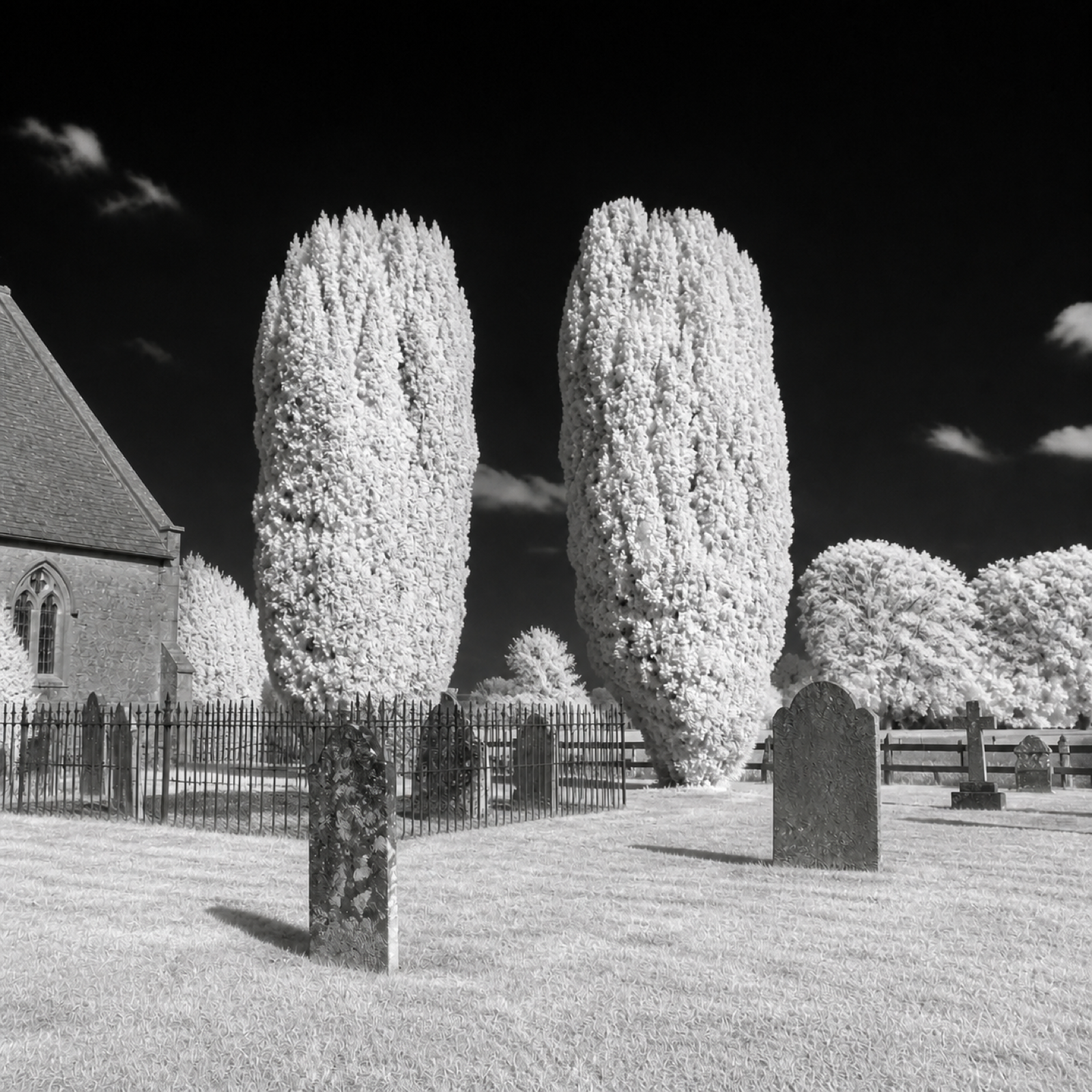
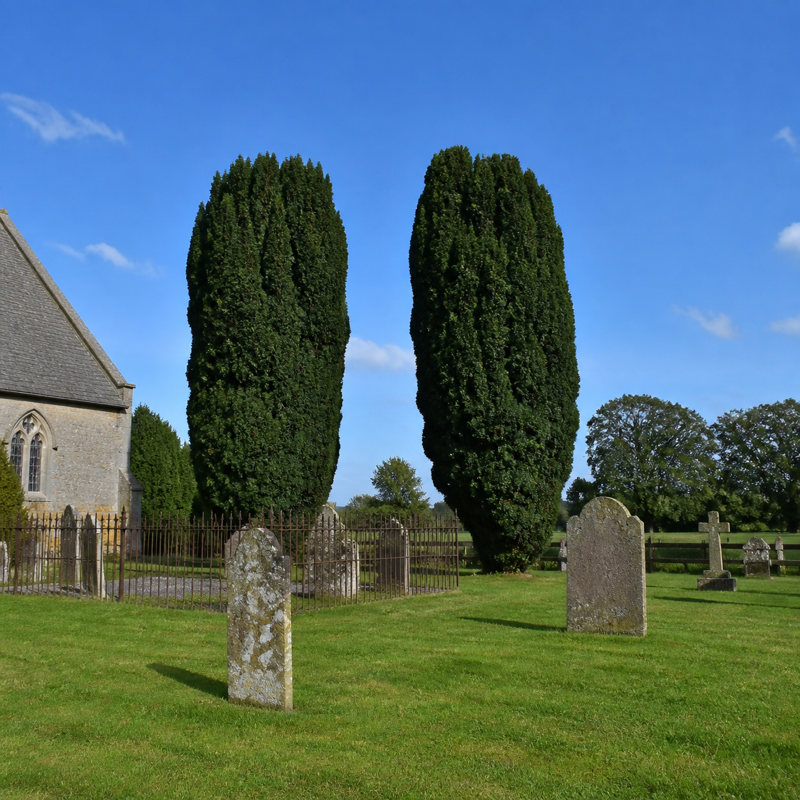
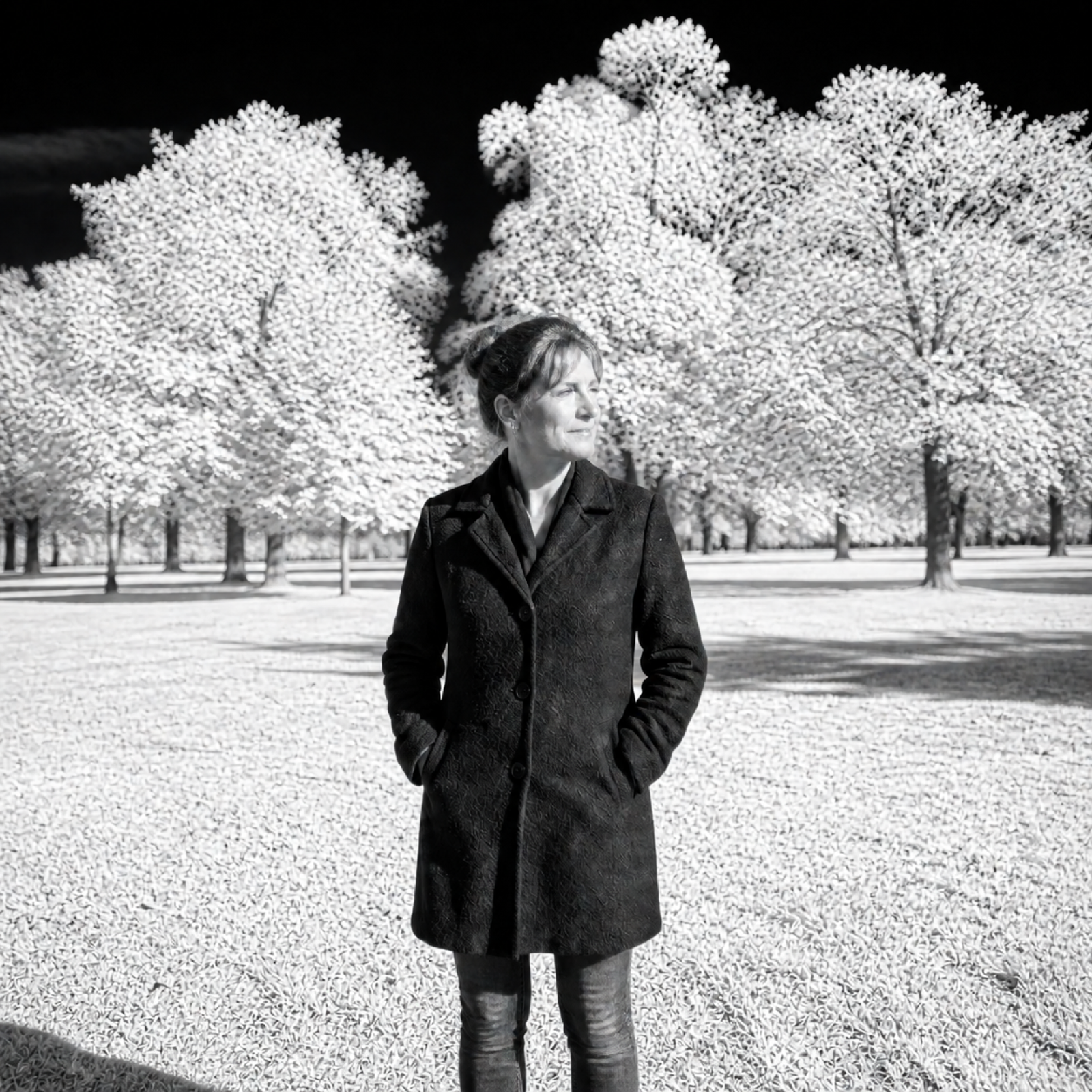
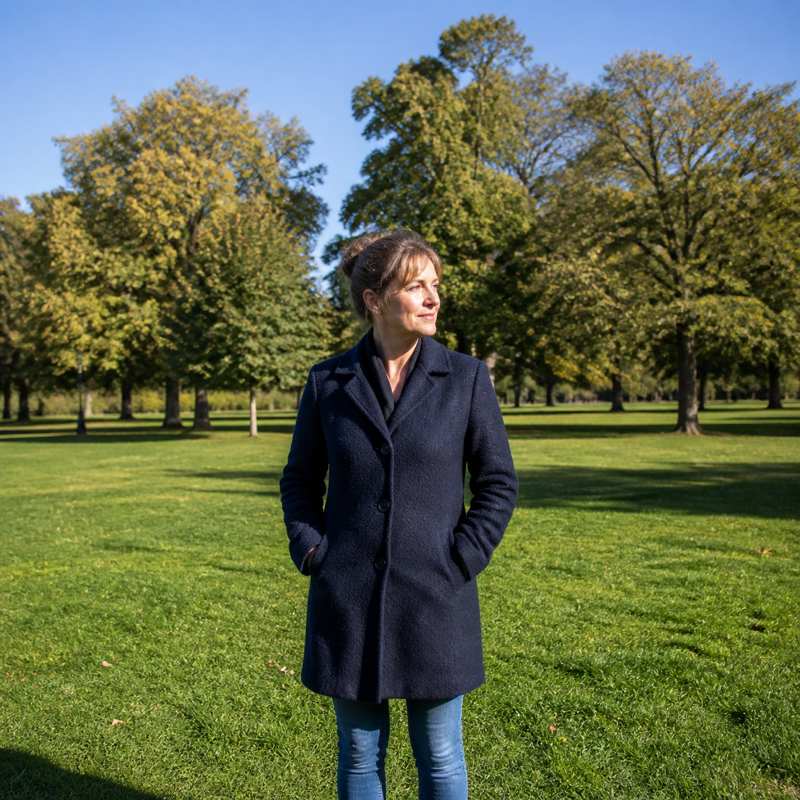
One treatment, two different photographs. A sunlit churchyard and a woman standing in a park — one to show what happens to stone and sky, one to show what happens to skin and to a coat that is dark without being green.
This is the cleanest result in the set, and the numbers come off a single registered crop so there is nothing to argue with. Across the same few hundred pixels the blue sky falls from 156 to 17, the yew foliage climbs from 22 to 141, and the stone roof between them goes 124 to 114 — a factor of six up for the living thing, a factor of nine down for the sky, and nothing at all for the stone. The second run repeats it on grass and trees and adds the test that matters most: the woman's dark wool coat goes from 32 to 34, unmoved, because it is not alive. That contrast between what is green and what is merely dark is what makes the picture convincing, and it is why the first field asks you to sort them. Both results are true monochrome with no false-colour wash, and the clouds stay bright against a near-black sky, which is the detail people remember from real infrared.
Generated for this library
Input
  Alive       the grass, the yew trees and the ivy
  Not alive   the stone, the path and the railings
  Sky         clear blue with three small high clouds
              toward the left
  Photograph  churchyard.png (1254 x 1254)

Returned   1 image · 1:1 · the churchyard in infrared

foliage    yew needles 22 up to 141, a factor of six
sky        156 down to 17, and the small cloud stays
           bright against it
not-alive  the stone roof 124 to 114, essentially
           unchanged; a dark wool coat 32 to 34
place      same church, same trees, same gravestones,
           registered exactly
words none, in any scriptYou fill in 2 fields — the braced lines at the top. Everything below them is fixed.
- 1What in the picture is alive and green, and what is not
- 2The sky, and what is in it
Leaves Are Bright, the Sky Is Not
What this makes
Hand it a photograph and it takes the picture again on infrared film — where anything alive and green glows white and a clear sky goes almost black, because chlorophyll is a mirror at a wavelength the eye cannot see. Two fields.
You are given ONE photograph. Return ONE image: the same scene photographed again on infrared film. Follow every line. Replace only the FIELDS block; everything after it is fixed.
First — do you have the photograph and the fields?
Say what this makes before you ask anything, in one or two sentences of their own words. Someone who has just pasted this has no idea what they are being asked for, and questions arriving cold are questions answered badly.
If no photograph is attached, stop and ask for one. This re-photographs a particular place, so there has to be a picture of it.
If either field below still has braces around it, stop and ask. Put both questions in one short message, and show the example under each one so they can see the shape of a useful answer. Wait for the replies, then work. Never fill a brace yourself.
Ask in whatever language they are writing to you in. Translate the questions and the examples; do not make someone read English to tell you what they want.
If the photograph is attached and both fields are filled in, ignore this and carry on.
Fields — replace these two lines only
- What in the picture is alive and green, and what is not: {the living things, and the rest}
- The sky, and what is in it: {clear or clouded, and where}
The law everything else follows from
The object is untouched. The photograph of it is taken again.
Everything about the recording changes: a film sensitive past the red end of the spectrum, and a filter over the lens that stops visible light altogether. Nothing about the place changes. Same trees, same building, same path, same arrangement, same light direction. The leaves are still green; the film is simply looking at something else.
Chlorophyll is a mirror in the infrared
This is the whole rewrite, and it is one fact of botany.
A living leaf absorbs red and blue light to feed itself and reflects almost all of the near infrared, because absorbing it would cook the plant. To a film that sees only infrared, every growing thing is brilliantly, almost blindingly white. So:
- Grass, leaves, ivy, moss and crops go white — the brightest things in the picture, close to clipping, with detail only in their shadows.
- The brighter the plant is growing, the whiter it is. New growth is whitest; a dying branch is grey; dead leaves are dark.
- Anything that merely looks green stays dark. A green painted gate, a green car, artificial turf, green fabric — all record as ordinary mid or dark tones. That contrast is the most convincing thing you can put in the frame.
- Foliage takes on a slight glow at its edges, because it is reflecting so much from every side.
The sky and the clouds change places
- A clear sky goes near black. Blue light is filtered out and the atmosphere scatters very little infrared, so there is almost nothing for the film to record.
- Clouds stay bright white, because water droplets bounce infrared as readily as visible light. Against the dark sky they look lit from inside.
- The darker the sky the higher you look, so the top of the frame is darkest.
- Haze and distant mist mostly disappear: infrared cuts through them, so far hills come out clearer than they were.
Everything else
- Water goes very dark, nearly black, because it absorbs infrared almost completely. A pond becomes a hole in the picture.
- Stone, brick, concrete, road and paint record much as they would in ordinary monochrome, in the middle of the range.
- Skin goes pale and waxy, smooth and slightly translucent, with veins showing faintly beneath it. Eyes go dark and flat.
- Fabric varies unpredictably: some dyes are transparent to infrared and come out much paler than they look.
The picture is monochrome
- One channel, rendered as grey, from black to white, at strong contrast.
- Not a colour photograph with a blue or magenta wash. Infrared film has no colour of its own; the false-colour version is a different stock and this is not it.
- A little grain is right; a grain overlay is not.
- Slightly soft, because infrared focuses on a different plane from visible light.
The place does not change
- Same viewpoint, same framing, same arrangement, same number of things.
- Nothing added: no extra trees, no birds, no people, no cloud that was not in the second field.
- Shadows fall where they fell.
Never
- Text, numerals, a caption or a watermark anywhere, in any script.
- A false-colour treatment: pink trees, cyan skies, magenta grass.
- Light leaks, sprocket holes, film borders, scratches or applied age.
- A vignette, a frame or a mock-up.
- A subject the photograph did not contain.
What it should read as
The same afternoon, in the same churchyard, recorded by something that does not see what you see.
The whole template, in one piece. The steps below are the entire workflow.
How to use it
- Copy the whole template with the button above.
- Attach the photograph and paste the template in the same message.
- Replace the two FIELDS lines. Sort the greens into living and not-living; that sorting is the whole instruction.
- Check a painted green thing. If it came back as bright as the grass, the run tinted by colour instead of by what reflects infrared.
- Then check the sky. It should be dark enough that the clouds look lit from within.
What you swap
- What in the picture is alive and green, and what is not
- the grass, the yew trees and the ivy are alive; the stone, the path and the railings are not
- The sky, and what is in it
- clear blue with three small high clouds toward the left
Before it runs
- A photograph, attached to the message. This re-photographs a particular place, so there has to be a picture of it.
- Living plants in the frame. The whole effect is chlorophyll, and a picture with no growing thing in it comes back as an ordinary monochrome photograph.
- Knowing what is alive and what only looks green. Painted green railings, a green car and artificial grass all stay dark, and that contrast is the most convincing thing in the result.
- Sky, if you can. The swap — bright cloud on a near-black sky — is half of why this looks the way it does.
When to reach for it
When a landscape should look like somewhere else entirely: a cover, a title card, a print, a record sleeve. Templates in this genre ask for an infrared or surreal look and hand back a photograph with the colours pushed around, which changes the mood and leaves every tone in the same order it started in.
What changes
- One photograph in, one infrared exposure out — the same place, recorded at a wavelength you cannot see.
- Living foliage goes brilliant white, because chlorophyll reflects almost all near infrared.
- A clear sky goes near black and clouds stay bright, so the two swap places.
- Skin turns waxy and pale and veins show through, which is the tell on any portrait.
- One image, no false-colour filter, no grain overlay, no border.
Pairs with
- A Hole Has No Focal PlaneHand it a photograph and it takes the picture again through a pinhole — no lens, so nothing is ever truly sharp and nothing is ever more blurred than anything else, with the corners falling away because of simple geometry. Two fields.
- The Light Travels With the SensorHand it a photograph of a thing and it comes back as a flatbed scan — no perspective at all, and everything lifted off the glass falling to black within a couple of centimetres. Two fields.
- The Plate Cannot See RedHand it a photograph and it takes the picture again on a wet collodion plate — an emulsion blind to red and wide awake to blue, so lips go black, a sky goes blank white, and the whole look follows from that one fact. Two fields.