
The Face Has Only Six Marks
Hand it a photograph of somebody and it comes back as a small handmade collectible figure of them — you name the few features that have to survive, because a toy face has room for about six. Two fields.
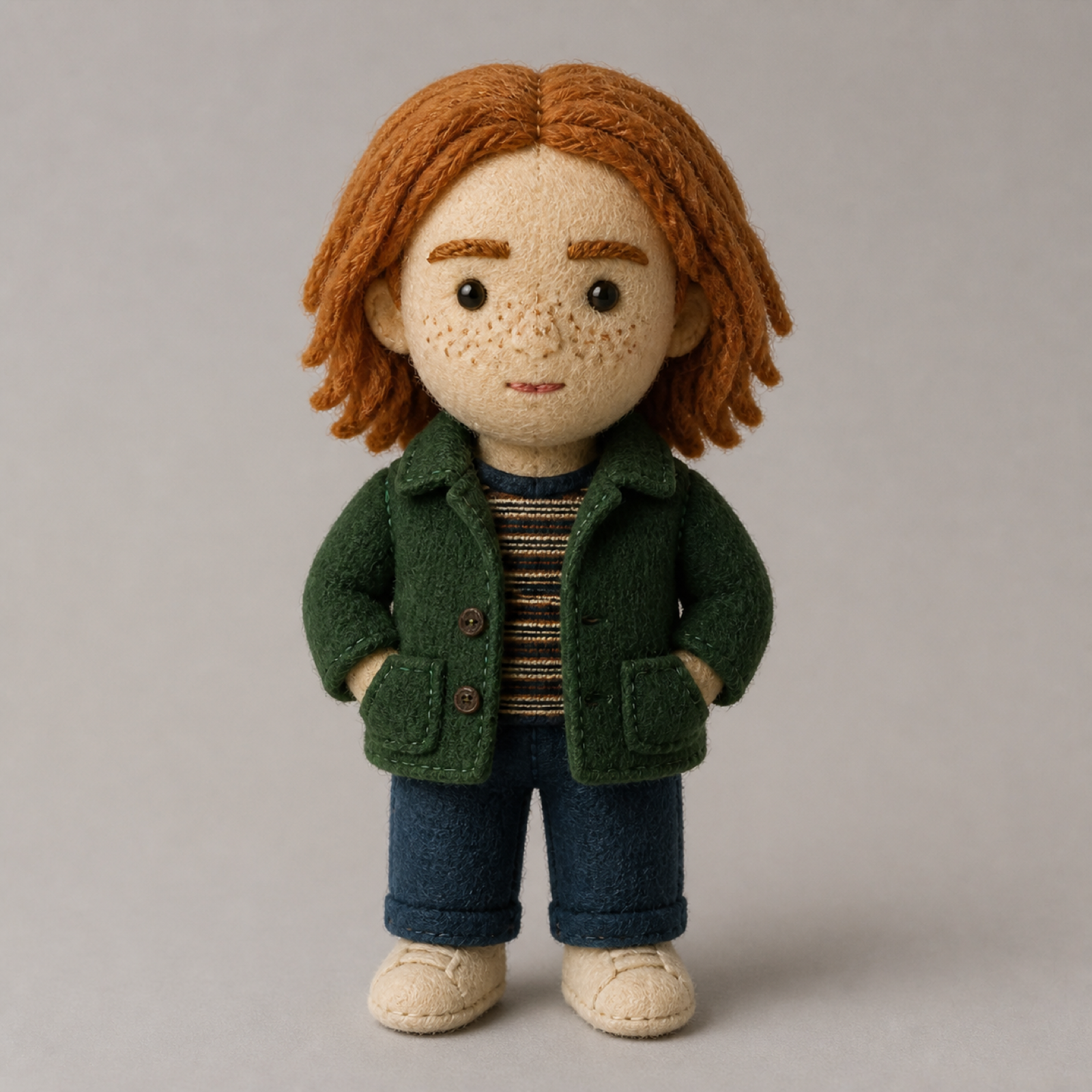
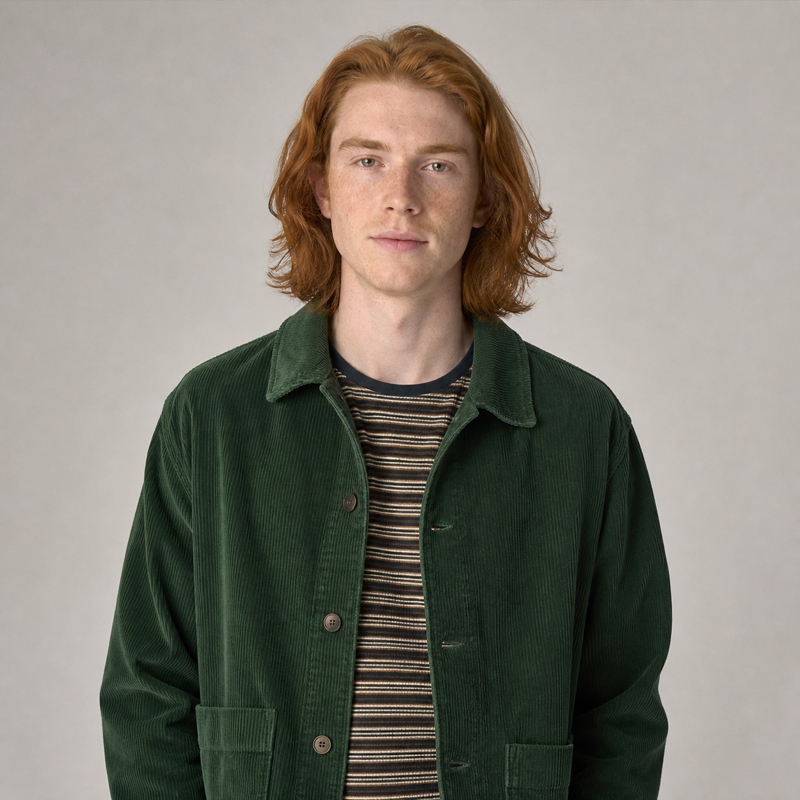
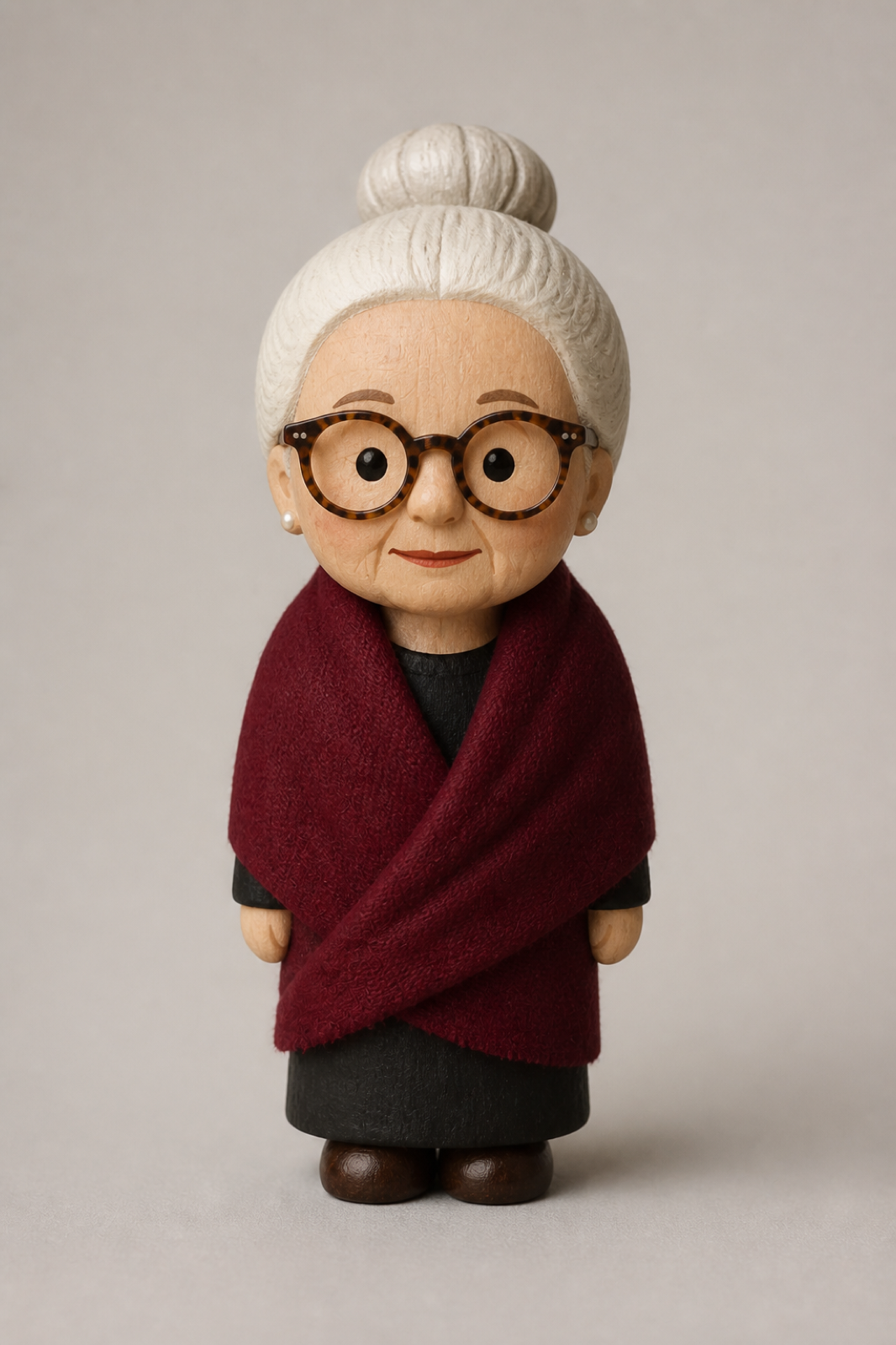

One treatment, two different photographs. A man in his twenties into stitched felt and a woman in her sixties into painted wood — two materials, two very different faces, and the same short list doing the work in both.
The list is what makes this work and both runs prove it: every feature named came back findable. Red hair parted in the middle, freckles stitched across the nose, thick straight brows, green corduroy on one; a high white bun, large round tortoiseshell glasses, a burgundy shawl and laugh lines on the other. Set beside their photographs both are recognisably those people rather than pleasant strangers, which is the thing the reference template cannot do — it asks for maximum facial resemblance and extreme accuracy, which are adjectives, and adjectives get you an average face. One miss, and it is the second field: the wooden figure does not read as turned wood. The shawl is cloth as asked and the features are painted, but the body has the same soft composite look as the felt one, with none of the grain the template asks the material to be honest about. Read the material field as a strong suggestion rather than a specification, and check the surface before shipping.
Generated for this library
Input
  Features    shoulder-length red hair parted in the
              middle · heavy freckles across the nose ·
              thick straight eyebrows · a green corduroy
              jacket
  Made of     stitched felt and fabric, with embroidered
              features and glass eyes
  Photograph  portrait.png (1254 x 1254)

Returned   1 image · 1:1 · one figure on a seamless

marks      all four found - the parted red hair, the
           freckles stitched across the nose, the thick
           straight brows, the green corduroy
material   felt, and honest about it: visible stitching,
           seams at the shoulders, glass eyes
identity   recognisably the same person beside the
           photograph, not a pleasant stranger
scene      nothing - one figure, plain ground, no props
           and no brand on anything
words none, in any scriptYou fill in 2 fields — the braced lines at the top. Everything below them is fixed.
- 1The features that make them recognisable, most important first
- 2What the figure is made of
The Face Has Only Six Marks
What this makes
Hand it a photograph of somebody and it comes back as a small handmade collectible figure of them — you name the few features that have to survive, because a toy face has room for about six. Two fields.
You are given ONE photograph of ONE person. Return ONE image: a small handmade collectible figure of that person, photographed plainly. Follow every line. Replace only the FIELDS block; everything after it is fixed.
First — do you have the photograph and the fields?
Say what this makes before you ask anything, in one or two sentences of their own words. Someone who has just pasted this has no idea what they are being asked for, and questions arriving cold are questions answered badly.
If no photograph is attached, stop and ask for one. The figure is of a particular person, so there has to be a picture of them.
If either field below still has braces around it, stop and ask. Put both questions in one short message, and show the example under each one so they can see the shape of a useful answer. Wait for the replies, then work. Never fill a brace yourself.
Ask in whatever language they are writing to you in. Translate the questions and the examples; do not make someone read English to tell you what they want.
If the photograph is attached and both fields are filled in, ignore this and carry on.
Fields — replace these two lines only
- The features that make them recognisable, most important first: {three to six features, in order}
- What the figure is made of: {a material, and how the features are made in it}
The law everything else follows from
Everything about how the subject is drawn may change. Nothing about what is in it may.
The person becomes an object: different proportions, different material, no photographic likeness at all. What may not change is who it is. A figure that could be anybody has failed even if it is beautiful, and that is the ordinary outcome here, because averaging a face is what a model does when nothing tells it which parts matter.
The face has only six marks
A toy face is a few embroidered or painted marks on a small curved surface. It cannot hold a likeness the way a photograph does, so recognition has to be spent deliberately:
- Work down the field's list in order. The first feature gets the clearest mark, the second the next, and so on. If the list runs longer than the face can hold, the ones at the end are dropped entirely rather than half-suggested.
- Every named feature is findable. Point at each item in the list and find it on the figure. A named feature that is not there is the failure this template exists to catch.
- Keep the asymmetries. One eyebrow higher, a crooked smile, a nose that bends — recognition rests on these more than on any regular feature, and they are the first thing a smoothing run removes.
- Hair is a shape, not strands. Its silhouette, its parting and its colour do most of the work; individual hairs do none.
- Glasses, facial hair and a strong garment colour count as marks and are worth spending one on, because they read at a glance.
Never average. If a feature is unusual in the photograph it stays unusual in the figure. A face that has been made pleasant is a face that has been made anonymous.
The figure
- Small, handmade, and clearly an object: a slightly oversized head on a smaller body, standing, facing the camera.
- Made of the material the second field names, and honest about it — visible stitching, wood grain, moulding seams, whatever that material actually shows.
- Clothing simplified to its colour blocks, with only the details the field named.
- Hands and feet simple. No fingers unless the material would have them.
The photograph of it
- One figure, standing on a plain seamless in a neutral colour that is not the figure's own.
- Soft even studio light, a soft contact shadow, sharp focus.
- Nothing else in frame: no props, no packaging, no hand holding it, no scene, no second figure.
Never
- A brand, a logo, a franchise character, or the proportions of any named commercial toy line. This is a handmade figure, not a particular company's product.
- Text, numerals or a signature anywhere, in any script.
- A scene, a story, a prop the fields did not name, or a giant hand.
- A second version of the figure, or a packaging mock-up.
- Smoothing, symmetrising or beautifying the face.
What it should read as
A figure somebody made of a person they know — small, plain, obviously handmade, and recognisable across a room to anybody who knows them.
The whole template, in one piece. The steps below are the entire workflow.
How to use it
- Copy the whole template with the button above.
- Attach the photograph and paste the template in the same message.
- Replace the two FIELDS lines. Put the most recognisable feature first — if only three things survive, you want them to be the first three.
- Check it by the list: point at each feature you named and find it on the figure. That is the test, and a figure that fails it is a nice toy of nobody.
- If it comes back smooth and symmetrical, the run has averaged the face; say which named feature is missing and run it again.
What you swap
- The features that make them recognisable, most important first
- shoulder-length red hair parted in the middle · heavy freckles across the nose · thick straight eyebrows · a green corduroy jacket
- What the figure is made of
- stitched felt and fabric, with embroidered features and glass eyes
Before it runs
- A photograph of the person, attached to the message, with the face clearly visible and reasonably lit.
- Permission from the person, if it is not you. A figure of somebody is a picture of them, and the fact that it is made of felt does not change whose face it is.
- Your own list of what makes them recognisable. This is the whole skill: the template spends the figure's few marks on what you name, and left to itself it spends them on nothing.
- Realistic expectations about faces. Six marks is what a toy face holds. Naming twelve features gets you the first six and a smoothed-over version of the rest.
When to reach for it
When a person should become an object: a leaving present, a team shelf, a shop mascot, a card. Templates in this genre ask for maximum facial resemblance and extreme accuracy, which is a pile of adjectives — the face they hand back is smooth, symmetrical and generically pleasant, and it is not the person.
What changes
- One photograph in, one figure out — a small handmade collectible, photographed plainly on a seamless.
- You name the features that have to survive, and each one is checkable against the photograph.
- A toy face carries about six marks, so the template spends them on what you named instead of smoothing everything into a pleasant stranger.
- The asymmetries come too — the crooked tooth, the uneven brow — because those are what recognition actually rests on.
- No brand, no franchise, no borrowed toy design: the material is a field and the proportions are the template's own.
Pairs with
- Enlarge What Is Already LargeHand it a portrait and it comes back as a caricature that is still unmistakably them — because it only exaggerates what the photograph already had most of, in the order you rank it. Two fields.
- Nobody Becomes a RelativeHand it a photograph of several people and it comes back as one stylised group portrait — everybody still themselves, because you name what tells each of them apart. Two fields.
- The Studio Changes, the Face Does NotHand it any photograph of somebody and it comes back as a proper studio portrait of them — new light, new background, new styling, and a face that is still theirs down to the features you named. Two fields.