

Small Things Are Photographed Close
Hand it a photograph taken from above and it takes the picture again as though the place were a model on a table — sharp only on one plane and falling off by distance, which is the thing that actually reads as small. Two fields.
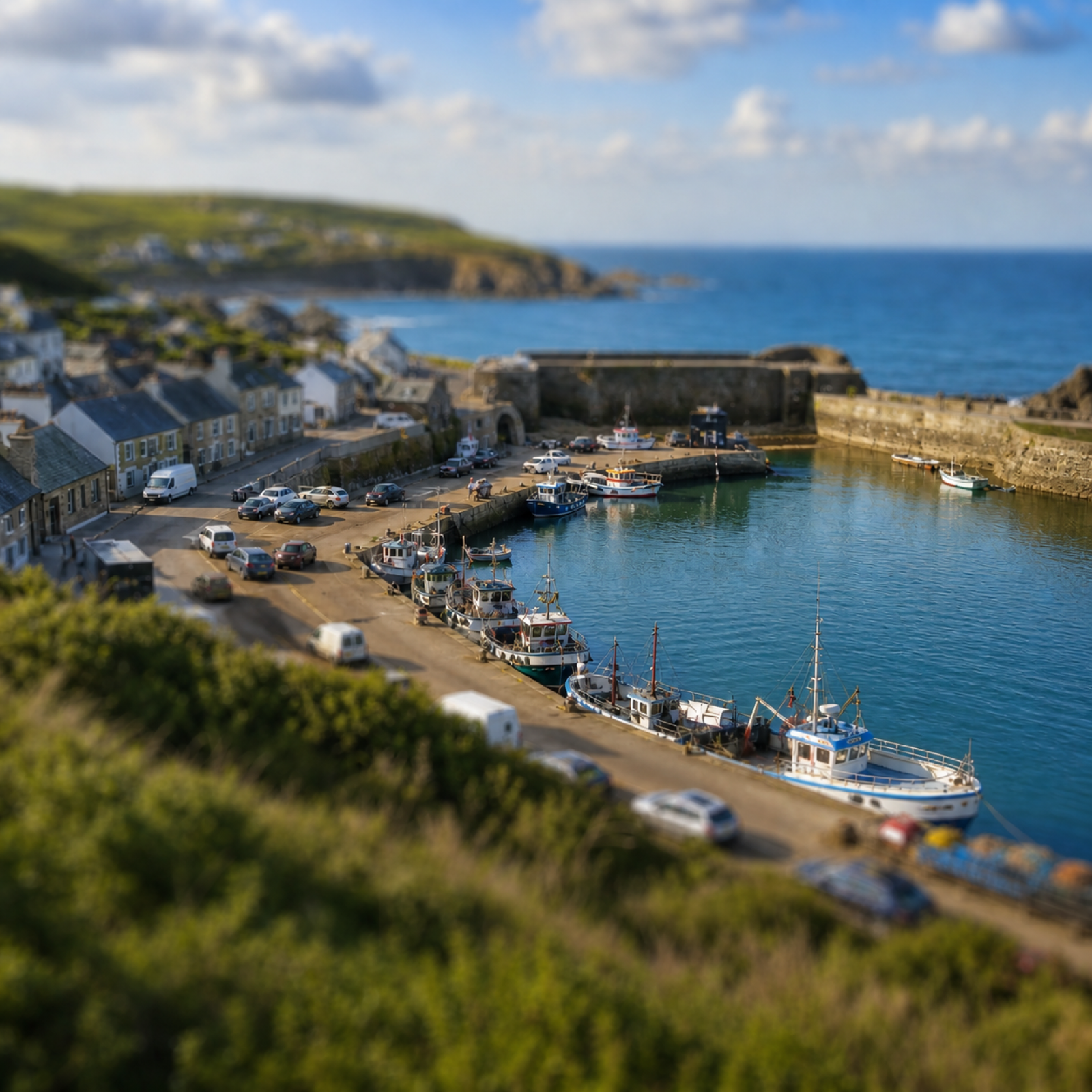
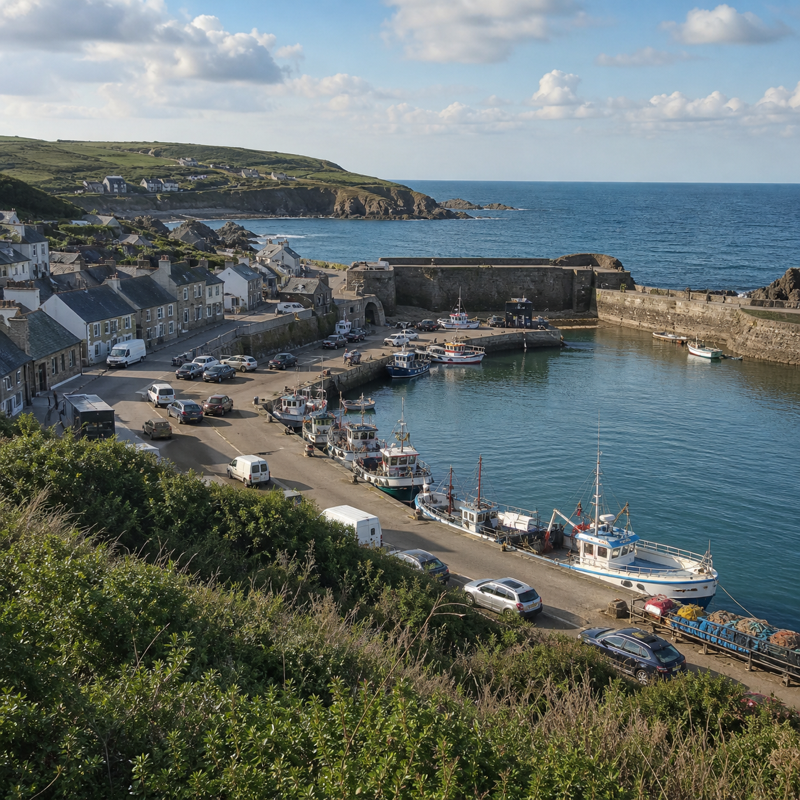
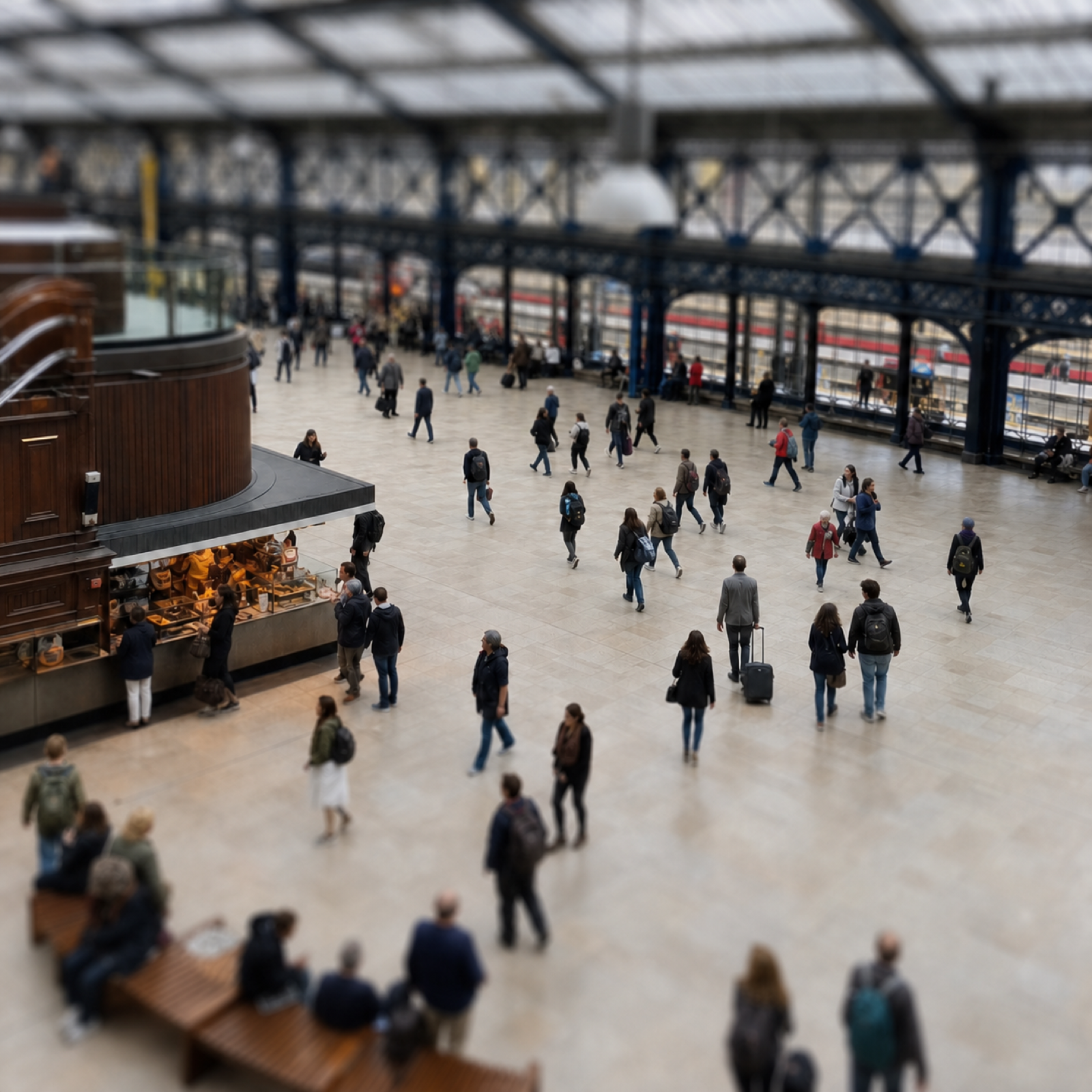
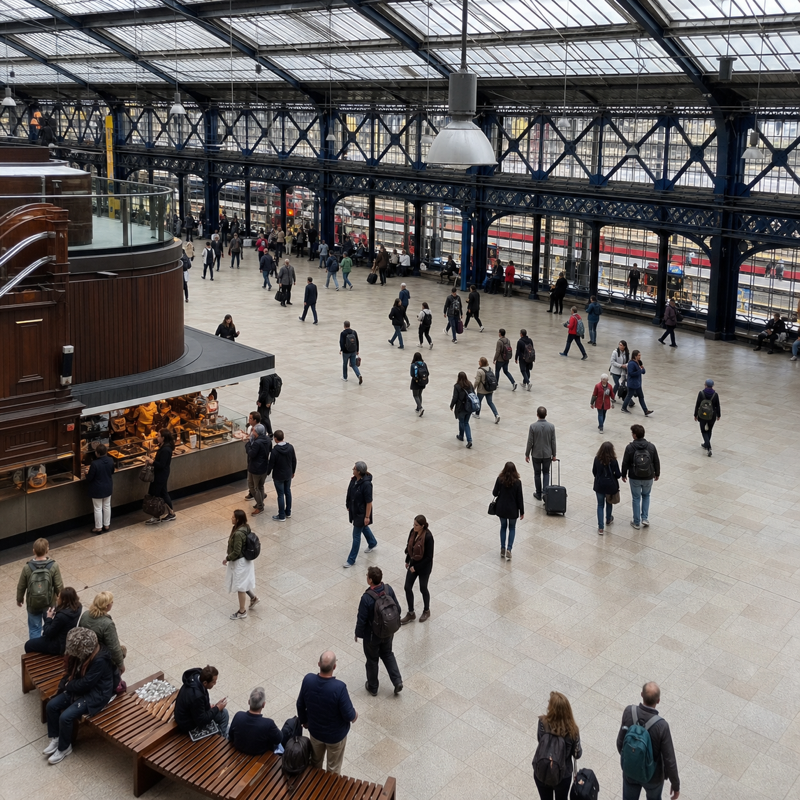
One treatment, two different photographs. A harbour whose quay runs diagonally and a station floor that recedes straight away — the first is the one that shows whether the focus is following distance or just height in the frame.
The rewrite is one sentence — focus falls off with distance, never with height in the frame — and it is the difference between a miniature and a blurred strip. It held. Measuring the harbour on a six-by-six grid, the sharp zone is not a horizontal band: it runs at about 9.5 to 9.9 in the middle-right cells and drops to 2.4 on the left of the same row, descending to the right along the quay exactly as the ground does. The near hedge and the far headland are both soft, which a band would also give you, but the diagonal is the part a band cannot fake. The station run behaves the same way down the recession of the floor. Colour did the other half of the work without being pushed too far: higher contrast, cleaner saturation, and the distance haze taken out of the far cliffs, which is what makes a model look like a model. Both keep every boat, car and person where the photograph had them. The thing to get right is the second field — name the nearest thing that should already be soft, and name something genuinely close, because a falloff that starts too far back leaves the picture looking like a photograph with a soft edge.
Generated for this library
Input
  In focus    the fishing boats along the quay, and
              nothing nearer or further than they are
  Falls off   the cars parked one row behind the boats
              are already soft
  Photograph  harbour.png (1254 x 1254)

Returned   1 image · 1:1 · the harbour as a model

plane      follows the quay, not the frame - measured
           across a 6x6 grid the sharp zone descends
           to the right with the ground
falloff    fast on both sides: the near hedge and the
           far headland are both soft
colour     more saturated, harder shadows, the haze of
           distance taken out of the far cliffs
place      same boats, same cars, same quay, same
           viewpoint, nothing added
words none, in any scriptYou fill in 2 fields — the braced lines at the top. Everything below them is fixed.
- 1What is in focus — one thing, at one distance
- 2How fast the focus falls away, said against something in the picture
Small Things Are Photographed Close
What this makes
Hand it a photograph taken from above and it takes the picture again as though the place were a model on a table — sharp only on one plane and falling off by distance, which is the thing that actually reads as small. Two fields.
You are given ONE photograph taken from above. Return ONE image: the same place, photographed again as though it were a model on a table. Follow every line. Replace only the FIELDS block; everything after it is fixed.
First — do you have the photograph and the fields?
Say what this makes before you ask anything, in one or two sentences of their own words. Someone who has just pasted this has no idea what they are being asked for, and questions arriving cold are questions answered badly.
If no photograph is attached, stop and ask for one. This re-photographs a particular place, so there has to be a picture of it.
If either field below still has braces around it, stop and ask. Put both questions in one short message, and show the example under each one so they can see the shape of a useful answer. Wait for the replies, then work. Never fill a brace yourself.
Ask in whatever language they are writing to you in. Translate the questions and the examples; do not make someone read English to tell you what they want.
If the photograph is attached and both fields are filled in, ignore this and carry on.
Fields — replace these two lines only
- What is in focus — one thing, at one distance: {one named thing}
- How fast the focus falls away, said against something in the picture: {the nearest thing already soft}
The law everything else follows from
The object is untouched. The photograph of it is taken again.
Everything about the picture changes: the lens, the aperture, the plane of focus, the colour. Nothing about the place changes. Same buildings, same boats, same cars, same people, same positions, same light direction. It is that place, photographed as though it were small.
Size is read from how quickly focus falls away
This is the whole rewrite. A viewer decides how big something is from how close the camera had to be. A camera far from a big place has everything sharp; a camera a few inches from a model has a plane of focus a few centimetres deep and everything else soft. That falloff is the only real signal, and it is a function of distance — never of where something sits in the frame.
So:
- Sharpness follows the things at the named distance, wherever they appear in the picture. If the quay runs diagonally, the sharp zone runs diagonally with it.
- The sharp zone is narrow: the thing named in the first field, and very little else.
- Everything nearer and everything further falls off, and both do so at a rate set by the second field.
- The falloff is smooth and it is fast, the way a close lens is, not a gentle haze.
Never blur a horizontal band across the top and bottom of the frame. That is the mark of the effect being faked, and it is wrong wherever the ground is not flat, wherever something tall stands up, and wherever the view is not straight down a street. A building rising through the sharp zone is sharp at the storey that is at that distance and soft above and below it.
The light of a lit model
- Contrast is higher than the photograph's, and the shadows are a little harder.
- Colours are more saturated, the way painted models are painted: cleaner reds, greener greens, less atmospheric grey in the distance.
- The haze of distance is removed. A model has no air in it, so far things are as clear in colour as near ones, even where they are out of focus.
- The direction of the light does not change.
The place does not change
- Same viewpoint, same framing, same focal length, nothing cropped.
- Same buildings, vehicles, boats, street furniture and people, in the same positions and the same numbers.
- Nothing is made to look like a toy. No plastic sheen, no moulded edges, no seams, no oversized simplification. The things stay real and the photograph makes them small.
- No props added: no giant hands, no rulers, no baseboard, no table edge.
Never
- Text, numerals, a caption or a watermark anywhere, in any script.
- A straight horizontal blurred band at the top and bottom.
- A vignette, a frame, a border, a filter or a light leak.
- Plastic or toy-like rendering of the subjects.
- A subject the photograph did not contain.
What it should read as
A photograph of a very good model — and the giveaway is the focus, not the paint.
The whole template, in one piece. The steps below are the entire workflow.
How to use it
- Copy the whole template with the button above.
- Attach the photograph and paste the template in the same message.
- Replace the two FIELDS lines. Choose the falloff by naming the nearest thing that should already be soft.
- Check where the sharpness runs. It should follow the things at that distance, bending with the ground — not lie in a straight horizontal band across the frame.
- If it still reads as a big place, the sharp zone is probably too deep. Name something closer as already soft.
What you swap
- What is in focus — one thing, at one distance
- the fishing boats along the quay, and nothing nearer or further than they are
- How fast the focus falls away, said against something in the picture
- the cars parked one row behind the boats are already soft
Before it runs
- A photograph, attached to the message, taken from well above the subject. A picture shot at eye level cannot be made to look small, because a model is always looked down on.
- One thing at one distance to focus on. Naming two things at different distances asks the lens for something no lens does.
- A picture with real depth. If everything in it is the same distance away, nothing can fall off, and the result is just a photograph.
- Things whose real size is not obvious. A recognisable person's face or a legible sign tells the viewer the scale immediately and no amount of focus will argue with it.
When to reach for it
When a real place should look like a model: a title card, a cover, a map illustration, an explainer. Templates in this genre ask for a tilt-shift miniature effect and hand back a blurred strip across the top and bottom of the frame, which is a gradient rather than a lens and which anybody can see is fake.
What changes
- One photograph in, one miniature out — the same place, photographed as though it were small.
- Focus falls off with distance from one named plane, not with height up the picture.
- The sharp band runs along whatever is actually at that distance, so it bends and follows the ground.
- Colour and contrast are pushed the way a lit model is lit, which does half the work of the illusion.
- One image, no vignette, no border, no toy props added to the scene.
Pairs with
- A Grade Moves No ShadowHand it a snapshot and it comes back graded — a named contrast curve, a named colour split, halation and grain — with every object, every shadow and the whole framing exactly where they were. Two fields.
- A Hole Has No Focal PlaneHand it a photograph and it takes the picture again through a pinhole — no lens, so nothing is ever truly sharp and nothing is ever more blurred than anything else, with the corners falling away because of simple geometry. Two fields.
- A Line at a Constant HeightHand it a photograph and it comes back as contour lines — every line a closed loop at one depth, none of them crossing, none of them stopping in mid-air, with the spacing doing all the shading. Two fields.