

Contrast Dies With Distance
Hand it a photograph and it takes the picture again in fog — where contrast falls away by the same fraction every few paces, so the near thing keeps every bit of its own and the far thing is simply gone. Two fields.
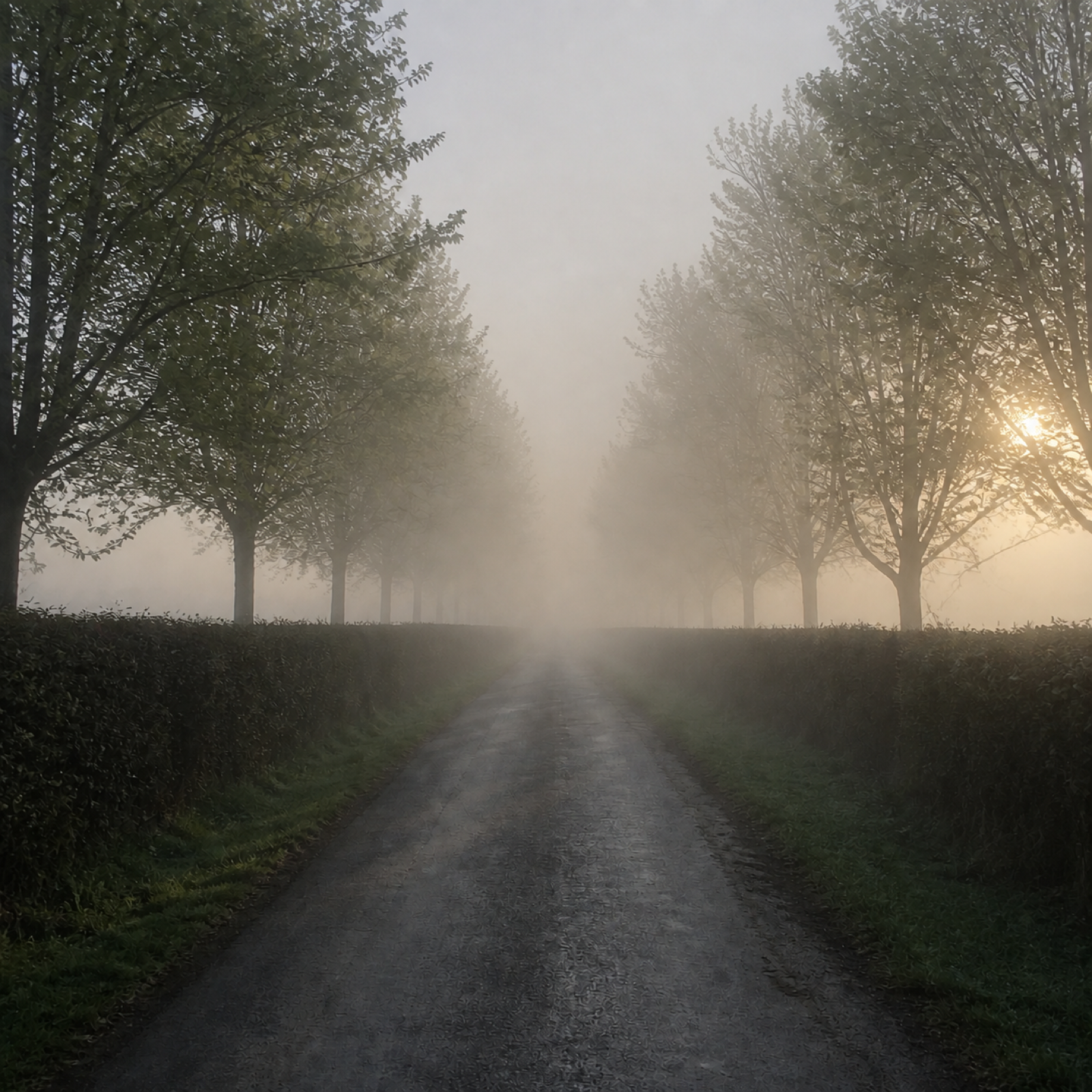
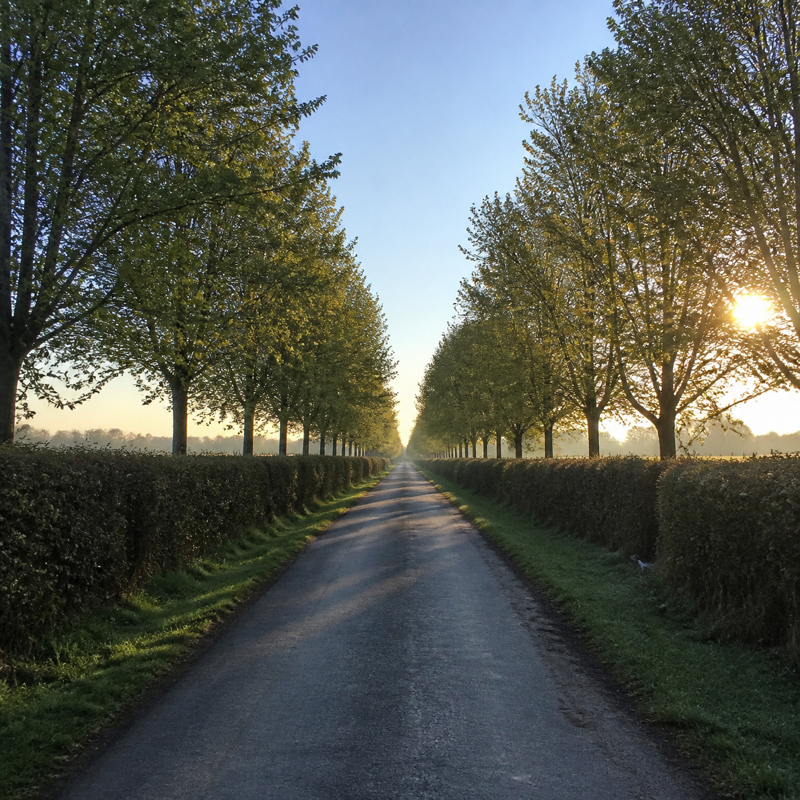
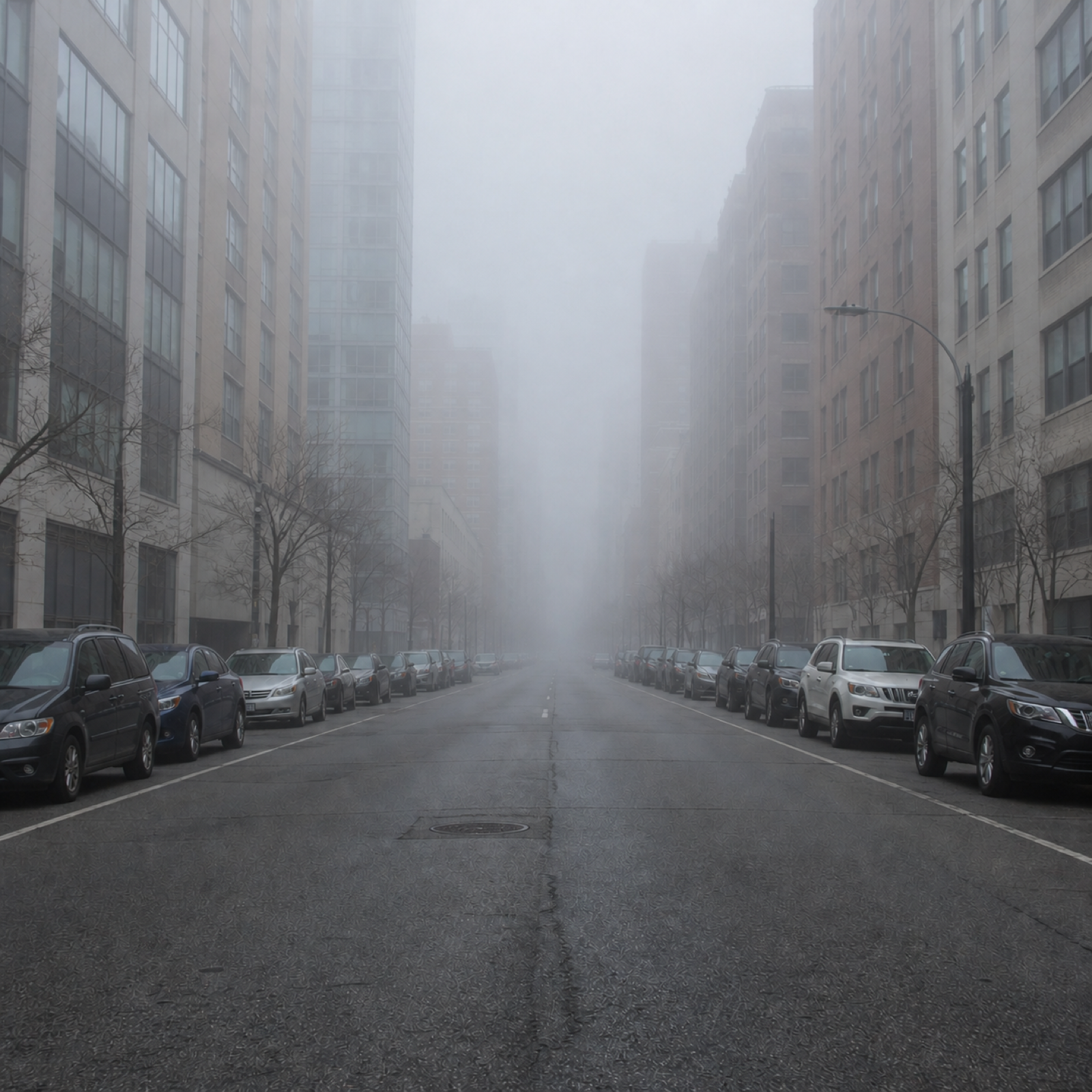
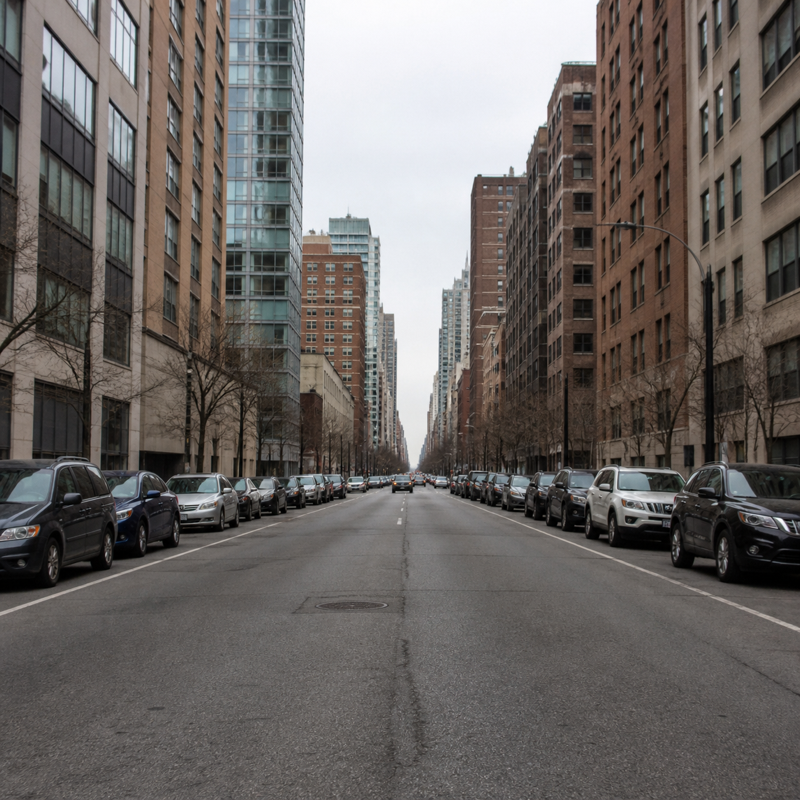
One treatment, two different photographs. A country lane with the sun low behind the trees and a straight city street — two ways of measuring distance, one in rows of trees and one in blocks.
The compounding is the point and it shows up in the numbers. Along the lane the near hedge keeps 82% of the contrast it had in the photograph, the middle row of trees keeps 78%, and the far end keeps 33% — slow at first and then steep, which is what a constant loss per unit of distance does and what an evenly laid haze cannot imitate. The near hedge still has its blacks, and that is what makes everything behind it read as far away rather than washed out. Past the limit named in the field the lane does not fade, it is simply gone. The city run does the same down its blocks: the parked cars in front keep their full range and their colour, the third building along is pale, and the street ends in a wall of nothing. The sun in the first run is a wide soft glow rather than a disc, which is the fog being lit rather than a light drawn on top of it.
Generated for this library
Input
  Thickness   you can still make out the second row of
              trees, and nothing beyond it
  Fog colour  a warm grey, brighter toward the low sun
              behind the trees on the right
  Photograph  lane.png (1254 x 1254)

Returned   1 image · 1:1 · the same lane in fog

near       the hedge and the near road keep their
           blacks - 82% of the contrast they had
falloff    compounding rather than even: 0.82 near,
           0.78 at the middle trees, 0.33 at the far
           end of the lane
limit      past the second row of trees the lane is
           gone rather than faint
colour     warm grey, and the low sun is a wide soft
           glow rather than a disc
words none, in any scriptYou fill in 2 fields — the braced lines at the top. Everything below them is fixed.
- 1How thick the fog is, said as the furthest thing you can still make out
- 2The fog's own colour, and where the light is coming from
Contrast Dies With Distance
What this makes
Hand it a photograph and it takes the picture again in fog — where contrast falls away by the same fraction every few paces, so the near thing keeps every bit of its own and the far thing is simply gone. Two fields.
You are given ONE photograph. Return ONE image: the same place photographed again in fog. Follow every line. Replace only the FIELDS block; everything after it is fixed.
First — do you have the photograph and the fields?
Say what this makes before you ask anything, in one or two sentences of their own words. Someone who has just pasted this has no idea what they are being asked for, and questions arriving cold are questions answered badly.
If no photograph is attached, stop and ask for one. This re-photographs a particular place, so there has to be a picture of it.
If either field below still has braces around it, stop and ask. Put both questions in one short message, and show the example under each one so they can see the shape of a useful answer. Wait for the replies, then work. Never fill a brace yourself.
Ask in whatever language they are writing to you in. Translate the questions and the examples; do not make someone read English to tell you what they want.
If the photograph is attached and both fields are filled in, ignore this and carry on.
Fields — replace these two lines only
- How thick the fog is, said as the furthest thing you can still make out: {a named thing, and nothing beyond it}
- The fog's own colour, and where the light is coming from: {a colour, and a direction}
The law everything else follows from
The object is untouched. The photograph of it is taken again.
Everything about the air changes. Nothing about the place changes: same lane, same trees, same buildings, same arrangement, same positions, same time of day. It is that scene, on a morning when you could not see the end of it.
Contrast falls by the same fraction every few paces
This is the whole rewrite, and it is one line of physics.
Fog does two things at once: it eats the light coming from an object, and it adds its own scattered light in front of it. Both happen at a constant rate per distance, so contrast is multiplied by the same fraction for every few paces further away. It does not fall in equal steps. It compounds. So:
- The nearest thing in the picture keeps its full range, blacks and all, exactly as it was in the photograph.
- Something twice as far away has lost far more than twice as much. The drop is slow at first and then very fast.
- Past a certain distance there is nothing left at all — not a faint shape, not a hint. That distance is the one the first field names.
- Everything converges toward one value, the fog's own, so distant darks lighten and distant lights darken until both are the fog.
If the near things have gone milky along with the far ones, a haze was laid over the picture and no air was put into it.
Fog dissolves, it does not blur
- Edges lose contrast, not sharpness. A far tree is a soft-edged pale shape because there is almost no difference between it and the air, not because it is out of focus.
- Focus does not change. Whatever the camera was focused on stays focused.
- Fine detail disappears by losing its contrast with what is around it, which happens sooner than the shape does — so a distant tree keeps its outline long after its branches have gone.
The fog has a colour and it has light in it
- It is the colour the second field names, and it is not white unless the field says so.
- It is brighter toward the light, and the brightness spreads: a sun in fog is a large soft glow, not a disc.
- Away from the light it is darker and cooler.
- A light in the fog lights the fog around it, in a visible ball whose size depends on the fog's thickness.
- Nothing in the scene is recoloured. Its colours fade toward the fog's, which is a different thing.
The place does not change
- Same viewpoint, same framing, same arrangement.
- Same objects in the same places, out to the limit — beyond that they are invisible, not absent.
- Nothing is added. No extra trees, no figures, no shafts of light, no birds, no lamps that were not there.
- Ground and near foliage may be wet, because fog wets things.
Never
- Text, numerals, a caption or a watermark anywhere, in any script.
- A white haze laid evenly over the whole frame.
- Volumetric light shafts, god rays, glows, bloom or a vignette.
- Blur, soft focus, a filter, a border, or a mock-up.
- A subject the photograph did not contain.
What it should read as
The same lane on a morning when you could see the first gate clearly and had to take the rest on trust.
The whole template, in one piece. The steps below are the entire workflow.
How to use it
- Copy the whole template with the button above.
- Attach the photograph and paste the template in the same message.
- Replace the two FIELDS lines. Set the limit by naming the last thing that should still be visible.
- Check the nearest object first. If it has lost its blacks, the run laid a haze over the whole picture instead of putting air between things.
- Then check the middle distance. The loss should be visibly faster further back, not a smooth even wash.
What you swap
- How thick the fog is, said as the furthest thing you can still make out
- you can still make out the second row of trees, and nothing beyond it
- The fog's own colour, and where the light is coming from
- a warm grey, brighter toward the low sun behind the trees on the right
Before it runs
- A photograph, attached to the message, with distance in it. Fog is a function of how far away things are, and a picture with everything at one distance comes back merely dimmer.
- Something close to the camera. Without a near thing at full contrast there is nothing for the fade to be measured against, and the result looks washed out rather than deep.
- A limit you can name. 'Thick fog' is a mood; 'you can still make out the second row of trees' is a distance the run can work to.
- Acceptance of losing the background completely. Whatever is past the limit is not faint — it is not there.
When to reach for it
When a picture needs air and depth without anything being added to it: a cover, a title card, a poster, a print. Templates in this genre ask for atmospheric fog and hand back a photograph with a white haze laid evenly over it, which flattens the near things and the far things by exactly the same amount.
What changes
- One photograph in, one foggy exposure out — same place, same hour, air you can see.
- Contrast falls by a fixed fraction for every few paces of distance, so the loss compounds rather than spreading evenly.
- The nearest thing keeps its full range, including its blacks, which is what makes the rest read as far away.
- Everything fades toward one colour — the fog's, not white — and edges dissolve rather than blurring.
- One image, no haze overlay, no glow, no border.
Pairs with
- Every Drop Is a LensHand it a photograph and it takes the picture again through a wet window — where each drop holds a small upside-down copy of what is behind it, sharp, while the scene itself goes soft. Two fields.
- A Grade Moves No ShadowHand it a snapshot and it comes back graded — a named contrast curve, a named colour split, halation and grain — with every object, every shadow and the whole framing exactly where they were. Two fields.
- A Hole Has No Focal PlaneHand it a photograph and it takes the picture again through a pinhole — no lens, so nothing is ever truly sharp and nothing is ever more blurred than anything else, with the corners falling away because of simple geometry. Two fields.